Jul 28, 2026
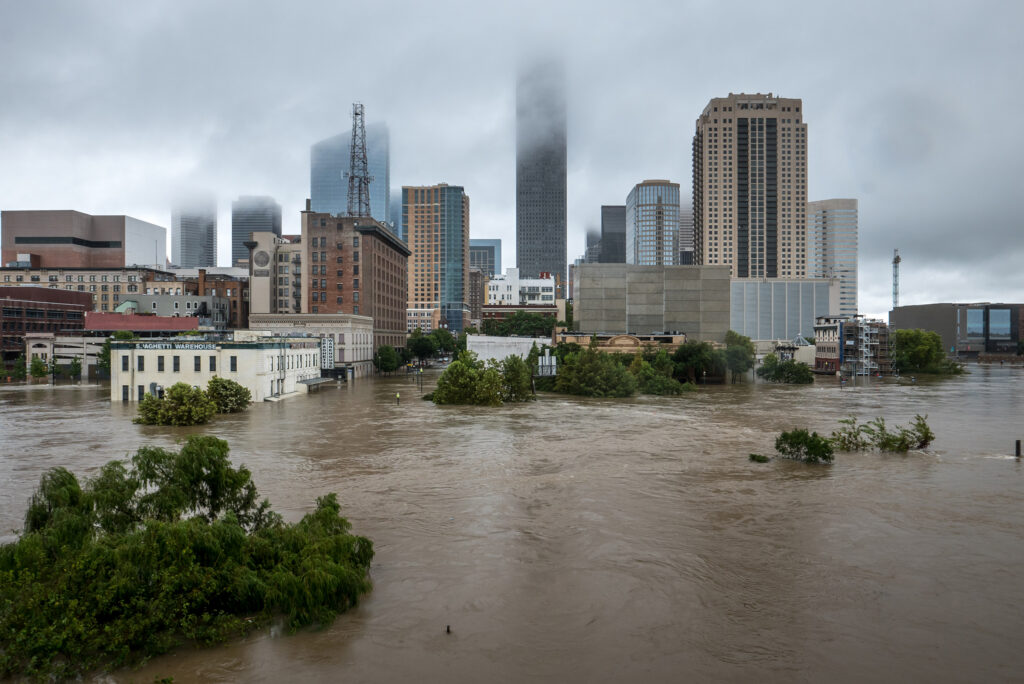
Water has the ability to connect and to divide in equal measure. It shapes the way we experience our communities,…

Designing data centers for a resource-constrained future
For all the noise surrounding data centers, there is, ironically, very little data—or reasoned discussion—on the subject. Data centers fit the bill of most industrial architecture: resource-heavy, sparsely inhabited, and prone to sustainability concerns, including various kinds of pollution, especially noise and light pollution. And much like other industrial forms of architecture—power plants, factories, and the like—people usually don’t like to have them built next to their communities.
Essentially digital processing plants, data centers are the new mission-critical archetype powering your Google searches, cloud storage, and any AI you may be using, knowingly or unknowingly. They are also increasingly part of Texas’s water conversation. These buildings do not simply consume land and electricity; depending on their cooling systems and energy sources, they can also require significant water. In a state already struggling with drought, groundwater stress, rapid growth, and aging infrastructure, the question is not whether data centers use water. They do. The more useful question is how much, where, under what design assumptions, and compared with what other demands.
Watching AI inhabit—or invade, rather—nearly every industry in the span of two years has been a lot to catch up with and to stay informed on. Data centers are the foundation that allowed this to happen, but it’s worth noting that they are far from a new project type. Data centers have been around for as long as digital servers have, the first established at the University of Pennsylvania in 1945.
In Texas, there are currently about 300 data centers, the exact figure depending on definitions. In total, though the exact number varies quite a lot, there are about 5,000 data centers in the U.S. Of course, AI and the potential use of generative AI in everyday work tasks have substantially and quickly caused a data center boom. Of the 300 or so Texas data centers, more than half have been built since 2020, and more than 150 are already planned by 2028—more than half of them in the Dallas–Fort Worth metro area.
To put this growth in perspective, by 2030, Texas is expected to have built more data center infrastructure in this decade than existed on Earth prior to 2020. Regardless of the explosive growth of data centers, their core design strategies—and our need for them to support digital infrastructure—have remained fairly constant for many years.
Speaking with experts on the topic—Josh Rosenthal, a studio director at Gensler Houston, and Chris Sanders, a data center practice leader in Gensler’s Dallas office—it seems that this trend is nothing new to those involved in the mission-critical side of architecture. Rosenthal and Sanders have both been involved in the Texas data center design scene for years, prior to the explosive rise in centers.
To them, the data center design trend, as well as its multitude of potential issues, started in 2020 with the COVID-19 pandemic. This makes sense, considering the entire world essentially went online for two years, and the work-from-home model became a standard, where it had previously been considered impossible, or at least impractical, at both the infrastructure and employee-employer levels.
However, the transition online was relatively smooth, at least as far as society-wide emergencies go, and infrastructure to support that shift was rapidly put in place to support an indefinite, potentially long-term, online presence for everyone.
Again, data centers had been around for decades, but their explosive rise to the top of revenue streams began when much of the developed world went digital during the pandemic. And so, the work on data centers was being done long before they reached mainstream discussion. The only thing that has changed significantly with the rise of AI is scale; quite simply, data centers need to be much larger than they used to be, and as such, they require more resources.
This issue of scale is among the biggest challenges regarding new construction, according to Tom Earp, a principal and engineering director at Stantec. The formula has not changed fundamentally in terms of data centers’ needs and challenges; it has grown to support the increasing prevalence of AI systems, which are much more energy-intensive than previous servers.
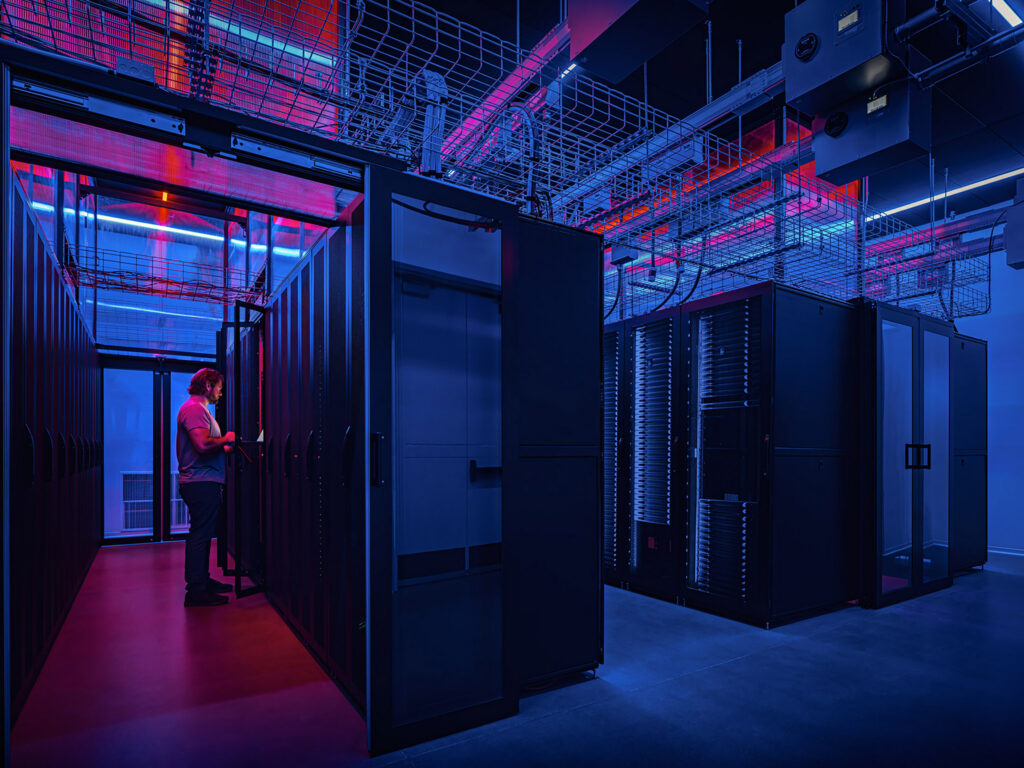
According to a 2025 analysis by SolarTech republished by the Independent Alliance of the Electrical Industry, traditional server racks tend to consume anywhere from 5 to 15 kW, while new AI-based server racks tend to consume anywhere from 40 kW to more than 100 kW at the top end. For large data centers, like those under Google, Amazon, and others, this industry shift is extreme, as those centers support millions of servers worldwide. It is no exaggeration to say that some centers could easily consume the full output of a traditionally mid-sized power plant.
The technology is also constantly changing as everything is being developed, making efficient, future-proof centers difficult to design. Earp explains, “As designers, we are put in this constantly interesting challenge of: How do we design a building that’s highly efficient based on what we know today about servers, and also recognize that this facility should still be relevant 15 or 20 years from now?”
Consequently, many of the larger centers are being built with that in mind, shooting for too much space rather than too little to suit their needs in the near future. Again, the issues we face seem to be an issue of growth and scale, rather than of the typology itself.
Speaking of resources, we should clarify the doom and gloom that often comes along with discussion of these new centers. Data centers do indeed use a lot of resources: Approximately 70 percent of their running costs come from electricity alone, and they use billions of gallons of water each year. This sounds terrifying, but there is context missing from these statistics.
First, although we are talking about running out of water in Texas, existing data centers account for a small share of the state’s total water use—roughly one percent today, with projections approaching three percent by 2030. To put this in perspective, Texas Water Development Board estimates for 2023 found that water use by industrial manufacturing and processing accounted for about eight percent of Texas’s water use, which is where that current one percent lies—alongside petrochemical plants, factories, and so forth. Household water accounted for 35 percent, and agricultural irrigation for a staggering 49 percent. The remaining percentage is broken into smaller categories, including mining, ranching, and other niches. While the water use of data centers is a real and delicate issue, it is far from the heart of the water crisis in Texas.
Additionally, recent regulation has been put in place to track water use. Beginning this year, data centers will be asked to report their water use to the state, whereas before reporting was optional. This is in addition to Senate Bill 6, passed in 2025, which addresses large electrical loads and grid planning in response to data centers and other high-demand users.
The centers themselves are also adapting, with many designs shifting toward closed-loop cooling systems instead of standard open-loop cooling systems. The difference is that closed-loop systems reuse and recirculate water before it either evaporates or is discharged as wastewater. This change can save a data center anywhere from one-third to 70 percent of its water use—so although data centers use millions of gallons of water, they have already made steps to cut back.
And while they also use a considerable amount of electricity, as we have seen, many are being built in Texas because the state has some of the cheapest and most abundant electricity in the world, a significant share of which comes from renewable energy sources like wind and solar. Furthermore, 2025 legislation requires certain large-load users, including many new data centers, to help fund upgrades to Texas’s energy grid in order to operate. (Ironically, we may have data centers to thank, in part, to a more resilient grid.)
Steve Amsbury, of Eaton, a supplier for data center energy systems, makes the point that data centers are too financially reliant on infrastructure to abuse it the way traditional industrial buildings often do. “Data centers are, after all, mission-critical facilities,” he says. “They are designed to operate 100 percent of the time, regardless of how things may go wrong. If a data center’s operation goes down, even for a minute or two, millions of dollars are on the line.”
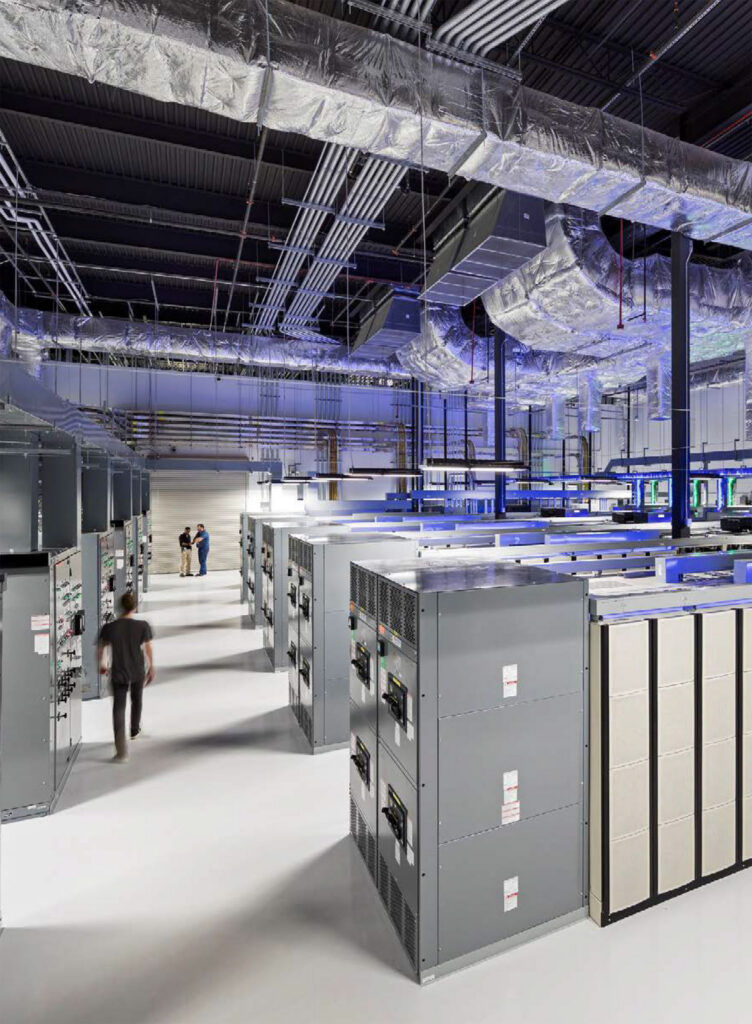
So where does the disparity lie between public consciousness and the reality of data centers? There is no single clear answer, but from what I can tell from my research, much of it has to do with two main ideas.
The first is that data centers have been conflated with cryptocurrency farms, which are abundant in Texas because of cheap energy and cheap land. Crypto farms, for those unfamiliar, spend an obscene amount of water and energy running computations for the chance to bring in cryptocurrency by verifying transactions and other bookkeeping items. This is how Bitcoin operates, and many other currencies follow this formula with some variation.
At one point, it was thought that crypto would replace traditional currency for its ability to be securely and privately tracked via the blockchain, as well as for the blockchain’s ability to store information securely, like digital licenses, deeds, signatures, and so on. But so far, these speculative uses have failed to become mainstream.
In reality, these “farms” consume a substantial amount of energy and contribute little back to Texas. Ironically, some farms made more money selling their power back to the grid during emergencies than they did running their operations, which says a lot about that industry. And unfortunately, these farms look much like the data centers built by Google, Microsoft, and other multinational tech companies that have legitimate utility.
The second disparity stems from a convergence of infrastructure issues coming home to roost just as these facilities are being built. Data centers are taking the blame for problems that have gone unaddressed for years because they are new—and because there are so many of them.
For decades, oil refineries, industrial farms, and semiconductor facilities have strained Texas’s infrastructure while polluting the environment. Long before the rise of data centers, these industries consumed far more water and electricity than data centers do today, even accounting for projected growth. They have also operated for decades with relatively limited regulation. Waste from refineries and industrial farms has been a longstanding problem, as has their continued withdrawal of water from sources such as Lake Corpus Christi.
This brings us to a very hard-to-swallow fact about sustainability and the way we’ve structured society. If you have ever owned and driven a car—which likely includes most readers—you have almost certainly caused more environmental damage and contributed more to climate change than any AI super-user.
For perspective, using the per-query consumption figure shared by OpenAI CEO Sam Altman (.34 watt-hours of electricity), you would need to make several million AI queries, depending on the intensity of the task, to generate a carbon footprint equivalent to that of an average car over its lifetime, including its production, maintenance, and fuel consumption. While that estimate is controversial and the exact number of prompts hard to say, the point stands that our issue is not with electricity consumption, but with electricity production via fossil fuels. And the above estimate is for a single vehicle. Most people will own several cars over their lifetime, potentially pushing the equivalent number of AI prompts further into the millions. It is also worth remembering that we are still in the earliest stage of AI development—the technology’s least efficient and least productive phase. Since large language models became publicly available, their efficiency has steadily improved.
To be clear, I am not an advocate of AI, and I am deeply concerned about the way it has been developing. There are plenty of issues with AI beyond sustainability, many of them freighted with ethical considerations. However, the reality is that AI is not a significant contributor to the environmental crises we face; our dependence on fossil fuels is.
This also brings us to another uncomfortable reality for architecture. As we all know, the built environment is a major contributor to climate change, with building construction and operations accounting for more than a third of global CO2 emissions. Designing unsustainable buildings—whether through the unnecessary use of concrete, steel, and glazing or by shipping materials instead of using what is locally available—put us in a precarious position long before the data center boom.
Architects have played a far greater role in creating this situation than data and technology companies, and it is a reality that the profession needs to confront more directly. Fortunately, many industry leaders have begun to do just that.
Gensler, for example, is working toward a carbon-neutral operations and production by 2030, and its work on data centers is no exception. Microsoft recently collaborated with Gensler on data centers in Virginia that use mass timber rather than the concrete-box aesthetic that dominates much of the sector.
This may come as a surprise given Microsoft’s role in advancing AI and digital infrastructure, but the company has set an even more ambitious goal than carbon neutrality, aiming to become carbon negative. Stantec, which recently absorbed Page and has emerged as one of the major players in the data center boom, has adopted a similar trajectory. The firm is targeting carbon-neutral operations by 2030 and embodied carbon neutrality by 2040, with its data center portfolio included in those commitments.
As in politics, it is easy to identify a scapegoat and assign blame. The more difficult truth is that responsibility for the crises we face is widely shared. Whether the issue is infrastructure, resource management, climate change, or another society-wide challenge, we all play some role in shaping priorities—whether as designers specifying concrete or as citizens who drive cars.
That does not mean data centers deserve a free pass; it means they deserve better design. Their environmental impact will depend less on the abstract fact of their existence than on the choices made around siting, cooling, energy sourcing, water reuse, and grid integration. A data center built in the wrong place, drawing potable water from an already stressed basin and relying on a fragile grid, is not the same proposition as one designed around closed-loop cooling, reclaimed water, renewable power, waste-heat reuse, and measurable infrastructure investment.
Data centers are not simply technological objects or industrial sheds at the edge of town. They are architectural and infrastructural systems, tied directly to the future of water, power, land, and climate resilience in Texas. The question is not whether we can stop the digital world from needing physical buildings. We cannot. The question is whether we will design those buildings as another extractive layer on already strained systems—or as an opportunity to make the interdependence of energy, water, and architecture more visible, more accountable, and ultimately more responsible.

Cameron Klepac, Assoc. AIA, holds degrees in civil engineering and architecture and serves on the Texas Society of Architect’s Publications Committee. They are faculty at Blinn College, teaching courses in architecture, as well as yoga classes from time to time.

Desert, sky, and ocean converge at a remote retreat in Mexico.
Plunging into Texas Water Conservation
Where form and atmosphere converge
A luxury resort is made smaller and greener.
A room for every season
Corpus Christi’s water crisis reveals the challenges of planning for growth.
Reimagining a campus landmark after Harvey
A center for the arts sustains Rockport’s creative community.

The Why and How of a Rammed Earth Enclosure

Urban Shores: Towards Landscape-Based Coastal Adaptation
Anna Aslaug Lund, Ole Fryd & Gertrud Jørgensen
Danish Architectural Press 2025
Earthy, warm hues, such as amber, terracotta, and violet, bring a grounding touch to these new kitchen and bath products.

Really interesting article! I love how you combine the understanding that this surge of demand is coming, while still working with various stakeholders in mind.
This article is very informative. I agree we need more accountability for the buildings we let into the community.
Really Interesting read. I liked how it put into perspective the impact of data centers vs other players that are not buzz words right now. I am curious if the management of these centers is also something that is being considered. At LOXONE, we focus on future proofing and making sure that spaces are as energy efficient as possible to account for presence/occupancy and the controls for HVAC. I would love to learn more how architects and designers are thinking about this as well.
Great article, Cameron! Seems like this research could be the basis for how our government affairs committee begins to engage with lawmakers on how we can contribute to this important and highly relevant discussion.