
May 22, 2026
Delight often comes from the unexpected. I’m reminded of moments I’ve experienced in places like Siena, Italy, or San Miguel…

Thermal Delight in Architecture and the Continued Work of Lisa Heschong

The irony: that architect and author Lisa Heschong’s MIT thesis deadline hit at the same time a catastrophic blizzard piled so much snow on the Northeast, she had no choice but to bundle up and deliver her message about thermal delight by ski. And the coincidence: that the same master’s thesis was sealed on Valentine’s Day 1978, the receipt date for what would become a beloved architecture book, in print continuously for almost half a century and selling thousands of copies a year.
Almost 10 years after Heschong’s commanding ski trip, I read Thermal Delight in Architecture, having borrowed my roommate’s copy one day in Austin in 1987 to bring for break time at my beige and bleak mall job. At 78 pages, it promised a quick read, and I liked that it was culty. Its cover, picturing a sun hat aloft on a black background, was iconic, and the book seemed to be in the hands of every architecture student on the University of Texas campus. I was intrigued by the word “Delight” in the title, to the point where I hardly noticed the modifier “Thermal.” Delight was something I wanted more of. The word stood out to me as it did in Vitruvius’s famous maxim, where “delight” hung back, behind “firmness” and “commodity”—like the two were delight’s wingmen.
Before reading Heschong, I understood delight in architecture to be more of a one-liner, like Charles Moore’s “ironic columns” or “Duck” architecture. While I was expecting to read a lofty manifesto, Thermal Delight was a Practical Grammar—a contrast to the abstract, post-structuralist material which otherwise guided me. Heschong’s writing drew me out of my cerebral positions at the time. In the book’s introduction, Heschong refers modestly to the work as her “musings.” But as the text builds, so does her imminent ownership of the topic of delight in architecture. In the pages that follow, Heschong shares history, literature, art, sociology, physics, and biology to argue that delight is a building system as legitimate as the others, and it lives in the A-sheets of our drawings—provided for by the architectural discipline. Without delight there is no firmness or commodity.

Thermal Delight gave me my first satisfying understanding of sustainability before the word emerged as an architectural term. Up until then, I was familiar with the calls for radical change in Silent Spring and A Blueprint for Survival and thought Buckminster Fuller was cool but considered this material part of a subculture not topical to architecture. Reading Thermal Delight alerted me to the connection between a building and its environment—this at a time when pedagogy, and therefore I, focused on object buildings standing apart from their surroundings. Heschong’s characterization of buildings as “a way to modify a landscape to create more favorable microclimates” freed me to be straightforward and practical about design and its connection to life.
Delight is operative when sensations of warmth and coolness become meaningful and memorable, but it is not about constant and static physical comfort. Delight is synesthetic, and Heschong was perhaps the first architect to write about this multisensory imperative of architecture. That which composes pleasant experiences for multiple senses becomes an object of affection, whether it’s an everyday cultural ritual like a hot coffee or a religious object in the form of the sun. Heschong showed that these experiences are valued because we do not live in a “thermally neutral world,” as she calls it—a world which never did and never should exist. Heschong elaborates on this saying: “Since our thermal sensors are not distance receptors, that is, they cannot warn us that a place will be cold before it starts to chill our body, we have to rely on other senses to give us advance clues.”
Why don’t we feel a wistful fondness for HVAC equipment in the office plenum space and the rumbling it makes before it blows air? Why is a wall register not a beloved harbinger of thermal delight? Because these are no substitutes for real microclimates and their signifiers. We do, however, feel affection on a hot day for the beauty and scent of honeysuckle and mountain laurel, and some of us have an unlikely fondness for drinking water from a green vinyl garden hose. The scent of flowers is brought to us by the cooling breeze, and the taste of the water signifies a break from the heat as well. These are the “advance clues,” synesthetic microclimate constituents for which we feel affection because they allude to the relief that’s en route.
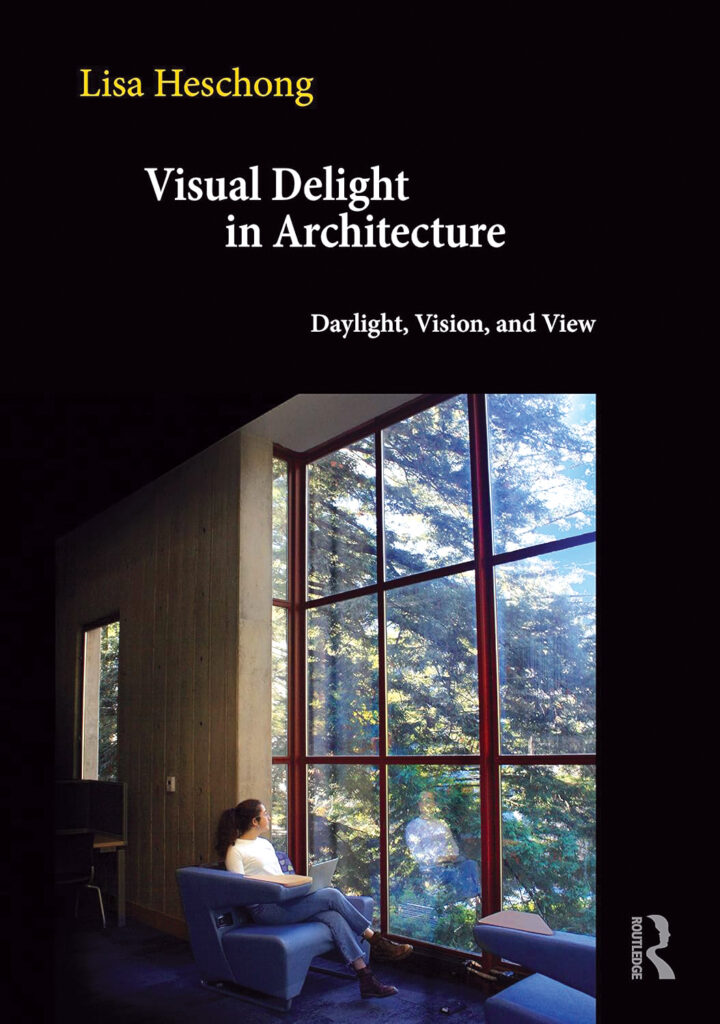
Heschong teaches in detail how we are never not processing sensory information. In Thermal Delight, she notes how the English idiom “I see” means “I understand,” an idea she would elaborate on 43 years later in Visual Delight in Architecture: Daylight, Vision, and View, a book about our visual experience of architecture from the inside out. Delight is still the heroine, this time on a 397-page journey, with glossary and index in hand.
In Thermal Delight, our skin is always looking for a particular microclimate to tell our brain about, and in Visual Delight, our eyes are always looking for signs of sunrise and sunset. “Ninety percent of our brain is involved in visual processing,” Heschong exclaims, regarding the importance of getting the visual experience right. Delight arises from this rich visual experience well beyond aesthetics or “momentary spectacle”—it is created from ongoing and attuned use of daylight and views that engage our senses in ways that support health, memory, and emotional connection to place. Buildings do not just shelter us and create microclimates; their fenestration entrains us.
In Thermal Delight, Heschong allows that a window seat can replace the feeling of a hearth, but in her decades of research, she finds that nothing can replace a window. Now a Fellow of the Illuminating Engineering Society, she came to this conclusion unplanned. While conducting post-occupancy surveys about lighting and daylight, she noted building occupants would ultimately talk about the views and how good these made them feel. The importance of views was underscored when Heschong asked her students at UC Santa Cruz to describe their favorite place on campus. The consensus surprised her: 28 of the 30 students chose the same spot—a seat near a particular library window. Intrigued, Heschong investigated further and discovered the library’s architect had made close-up views of the existing trees “a driving idea behind every design decision.” Views led the design brief and determined all other building systems.

That same window that Heschong’s students described also inspired a donor to gift millions of dollars toward the library’s renovation on the condition that the window never be changed. We know a view can multiply the asking price for a private property, yet we rarely carry this insight into our public work. Instead, we treat thoughtful microclimates and views as luxuries reserved for only a few lucky buildings—or the lucky people inside them. Though the value of views in public buildings may not show up in their resale price, Heschong points out that “the return on investment is that people care about your buildings, love them, and therefore take care of them,” yielding life cycle and environmental benefits. Following this line of reasoning, architects have the simple, ethical responsibility to avoid creating places that are sensory neutral and static so our buildings are valued, enjoyed, and kept in play—the very definition of firmness and commodity.
That our buildings should rightly have real daylight and views seems like no revelation, but so far we have only been able to argue about it in rhetorical terms. Who did not feel triumphant over the cancellation of Munger Hall, UC Santa Barbara’s windowless dorm? Its design met code, but the injustice for those who would have ended up in the 1.7 million-sf labyrinth, where virtual screens subbed for windows, offended everyone except the non-architect who designed it. The project should never have left the visioning phase, but no one had strong enough data to change its early course. Standards and benchmarking systems prescribe and incentivize natural light and views to an extent, but more so as bonuses than as design determinants. They struggle against the current of our tendency toward ever-brighter electrical lighting. We have spent a century illuminating space as if we cannot trust ourselves with natural light, and in doing so have helped create the “environmental generational amnesia” described by the psychologist Peter Kahn, a social ill where expectations about our experiences in a building are progressively downregulated. The consequence of forgetting how to design with natural light has grown from the occasional creation of a loathsome building into a full-blown health crisis.
Heschong has confirmed in her decades of research and practice that buildings ignoring the natural properties of daylight and views affect us in ways that are harmful to our health at all scales. She discusses in Visual Delight how, if we had maintained our capability to design well with daylight and sell it to our clients, we could have averted public health crises such as myopia, an irreversible condition skyrocketing in children. Because of these findings, Heschong now centers her work in the realm of public health and social justice, lecturing on emerging science about daylight and views, and what happens to occupants’ health when the two are eschewed.
“It’s a long way from delight to molecular mechanisms,” Heschong tells me in a phone call, but as I see it, she continues to dedicate herself to delight in architecture as she pursues “what is known and what is becoming known” of our visual experience from within a building. Heschong perseveres as she always has with her message, publishing papers and lecturing on discoveries related to vision, circadian rhythms, and neurobiology, with the intent that we will translate these findings into codes and Basis of Design documents. This is the work which will continue to give delight the credit it’s due—as a building system firmly within architects’ purview and directly tied to our well-being. Vitruvius included the word for a reason; he just didn’t have the data yet.

Laura Foster, AIA, has been a public sector architect for 15 years and currently practices in El Paso, where she lives in and is restoring the historic midcentury Hilles House.




On the Invisible Forces and Narrative Logics of Art and Design
An East Austin studio rises above the rest.
Redefining Suburban Recreational Architecture

A Watering Hole for the Ages
Cinematic drama meets fine cuisine.
Total Design for a New Era

Bruce Goff: Material Worlds
Art Institute of Chicago

The House of Dr Koolhaas
Françoise Fromonot with editor Thomas Weaver
Park Books, 2025

The rounded edges of these products align with the growing trend toward incorporating more organic, softer shapes and curves into hospitality interiors.