
May 22, 2026
Delight often comes from the unexpected. I’m reminded of moments I’ve experienced in places like Siena, Italy, or San Miguel…
On the Invisible Forces and Narrative Logics of Art and Design
Last year I had the privilege of speaking with an architect whose work is both mesmerizing in its complexity and humbling in its simplicity. I encountered a personality as receptive as it is fierce, notably devoid of clichés and platitudes. While discussing one of their projects that I highly respect, I was introduced to certain “tricks” and “exaggerations” employed in its development and execution. These terms intrigued me, pointing to a kind of ingenuity and narrative drive that broadened my understanding of how strong architectural projects are realized.
One goal of this essay is to acknowledge the myriad strategies and calibrations that facilitate projects but do not appear as visible features of the architecture. Considerations like funding, clients, program, building codes, and public relations must be craftily navigated for an exceptional project to take shape. Often consuming more time and energy than the design itself, these factors remain largely invisible to the public—and often to critics and colleagues as well. But they are owed their rightful due, and for the purposes of this essay, I will refer to them as tricks.
On the other hand, there are aspects of a project that are visible to everyone, and these are the narrative aspects of architecture. Scale, form, structure, and materials convey stories of culture and place. A second aim of this essay is to approach architecture explicitly as a storytelling device, one necessary for a culture to recognize itself and its dreams. Because storytelling is an art, and art is an intentional distortion of reality, I will refer to architectural narratives as exaggerations.
TRICKS
Architecture, like art, must grapple in order to exist. The world—at least the parts of it that finance the realms of art and architecture—tends to be either too resistant to change or too eager for it and is often slow to recognize the essential qualities of a given time and place. And yet, it always depends on the creative force of others to color its environment. For the purposes of this essay, I will conflate the roles of artist and architect, as both contend with similar challenges of creative expression within a cultural context.
The true skill of an artist is twofold. The first is craft: the ability to communicate in a particular medium. The second is craftiness: everything required, both within and beyond the medium, that allows the work to exist—what I respectfully refer to as tricks.
In this context, tricks rely on critical analysis, creative problem-solving, and persuasion; they are not shortcuts or gimmicks. They require an ever-expanding understanding of how things work at a fundamental level—culture, ecology, history, finance, planning, and production—along with the ability to understand other people’s needs and perspectives.
Tricks concern the alignment of desire and opportunity. They depend on an expanded awareness and influence across all phases of a project. In bridging the gap between ambition and limitation, tricks uncover opportunities within constraints.
Tricks make architecture possible, and our role models—whoever they may be—were and are very good at them.
EXAGGERATIONS
Whether we like it or not, architects are responsible for constructing public narratives around resources, culture, and technology through aesthetic expression. This responsibility requires architects to work symbolically and to engage in the craft of storytelling. Telling stories, it turns out, is a complicated business.
“Tell it by the fireside or in a marketplace or in a movie, almost any story is almost certainly some kind of lie,” said filmmaker Orson Welles, one of the preeminent storytellers of his medium. Artist Pablo Picasso also had a fixation on the ambiguities of truth: “We all know that art is not truth. Art is a lie that makes us realize truth, at least the truth that is given us to understand. The artist must know the manner whereby to convince others of the truthfulness of his lies. If he only shows in his work that he has searched, and re-searched, for the way to put over his lies, he would never accomplish anything.”
Today, we are inundated with misinformation, and lies are driving our cultural and political spheres as never before. But this only underscores the point: Facts yield to the arc of narrative, and narrative drives action.
Let us first establish the good faith that Welles and Picasso, as well as our architectural colleagues, generally possess. Those who enter the arts or architecture do not usually do so to deceive or mislead, or to become fabulously wealthy or famous (though Picasso and Welles are notable exceptions). Most of us are drawn in by a revelatory experience that lures us—against all reason—toward its source, instilling both gratitude and a desire to contribute something of our own.
Filmmaker Werner Herzog has spent his career chasing such experiences. “There is such a thing as poetic, ecstatic truth,” he wrote. “It is mysterious and elusive, and can be reached only through fabrication and imagination and stylization.”
Again, we run into words—fabrication, stylization—that challenge our perception of honesty, particularly when honesty—in construction, materials, and form—stands as a central tenet of modernism. What are we to make of this?
Committed to poetic and ecstatic truths, Herzog famously staged scenes in documentaries to expose the “truths” he sought to convey, occasionally turning his real subjects into willing actors. For Herzog, facts alone do not amount to truth. As he explains, “If you want to know the facts, ask an accountant. If you want to know the truth, ask a poet.”
If we think of the built environment as primarily a collection of facts, then architects are responsible for the poetry. As “poets,” we must engage with fabrication, imagination, and stylization—in other words, exaggerations.
Exaggerations are the elements of the architectural narrative that make it not only legible but also illuminating. Just as a good story is not simply a recitation of events, architecture is never merely a rational assemblage of elements. It is a rhetorical composition that must engage both the reality and imagination of its audience.
Many forms of exaggeration are derided for one reason or another, yet they all serve the same purpose: to communicate a feeling or idea. Exaggerations are how stories and art are created. There is no architecture without them. Whether crude or sublime, strident or restrained, every decision is intended to produce an effect, to tell a story. If that story amounts only to an exhibition of taste or brash confrontation, what is in it for the public other than to admire or revile?
Architecture should aspire to tell culturally relevant stories that can be shared with the general public, to aspire toward a realization of truth. The best artists are not threatened by the fabrications of their crafts. “I can paint fake Picassos as well as anybody else,” Picasso is reported to have once said, and that story has been told many times, including by Welles in his quasi-documentary F for Fake. Did Picasso actually say it? Does it matter? It is the insight and audacity of the idea that really matter, not its authenticity.
If this discussion seems to be moving too far afield, let’s bring it back to someone who might agree.
Mies van der Rohe spoke passionately and eloquently about his commitment to modern design: “The long path from material through function to creative work has only a single goal: to create order out of the desperate confusion of our time.” He wrote with conviction about integrity of form, structure, the honest use of materials, and the exclusion of ornament: “Form by itself does not exist—form as an aim is formalism; and that we reject!”
But Mies also understood something about tricks and exaggerations. While working on the Seagram Building in 1954, he found New York City’s 1916 Zoning Resolution to be limiting. In response, he introduced a plaza—ostensibly for public use—to accommodate a high-rise slab building with no setbacks, a form he had been dreaming about for decades. “A building with no setbacks, but all set back,” as described in Architectural Forum at the time. This maneuver allowed him to achieve the “form” he truly wanted. Judging by the level of development within the plaza, it is evident that Mies placed little emphasis on it as a public gesture. It was a trick—a means of realizing the form he had been dreaming about for decades.
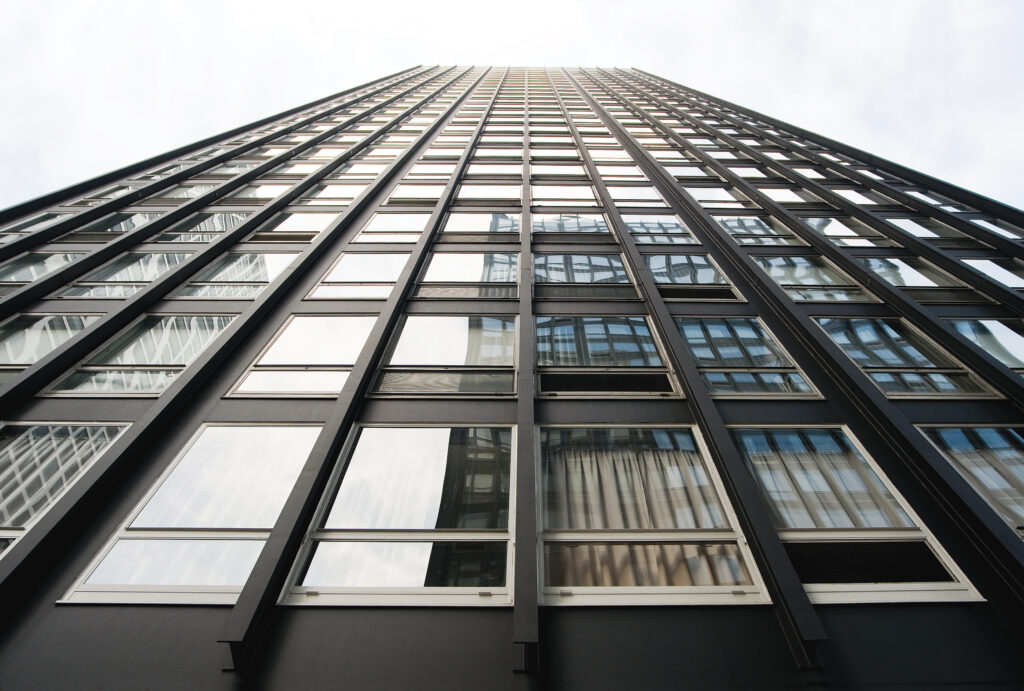
The Seagram facade is famously “ornamented” with vertical bronze mullions extruded in the form of structural I-beams, an exaggeration first developed a few years earlier at Mies’s first high-rise towers at the 860–880 Lake Shore Drive apartments in Chicago. When fire codes prevented the expression of structural steel elements in the residential twin towers, a decision had to be made. Mies understood that the expression of his formal ideals was more important than their reality, so he applied decorative I-beams to the facade to simulate the sense of structural order and purity he believed was so important for society to apprehend. Does anyone consider this a mistake? I doubt it, and most architects today likely accept the Miesian compromise far more readily than he ever did.
This exaggeration was worthwhile, however, because Mies had the poetic sensibility and artistic conviction to tell a story the world was ready to receive—one of an ascendent modernity, technology, clarity, and rationality. When a compelling idea is translated into a persuasive expression, reality recedes into a banal litany of facts. “The artist must know the manner whereby to convince others of the truthfulness of his lies,” Picasso reminds us.
Artist and self-identified architect Donald Judd was also adept in both tricks and exaggerations. After establishing a successful career in the art world, Judd grew dissatisfied with the transitory manner in which modern art was exhibited and the speculative way it was collected. In 1978, with the support of the Dia Art Foundation, he secured an abandoned military base in Marfa and created the Chinati Foundation, a museum of site-specific and permanently installed artworks that remain outside an art market that would undoubtedly pay dearly for them today.
How does an individual artist establish an independent museum far removed from the culture and economy of the art world? With ideas that knew no limits, paired with tactics that understood them intimately. In other words, through the use of tricks that enabled him to accomplish what few, if any, artists have achieved.
Building an entire museum from scratch would have been out of the question. The answer? Buy a large assemblage of disused buildings on nearly worthless land. Then, fix them up minimally one at a time and install works by yourself and your friends, who also happen to be defining artists of their era. There is an impossible combination of ambition and practicality to this scheme. Yet, it all feels so seamlessly brilliant and obvious today.
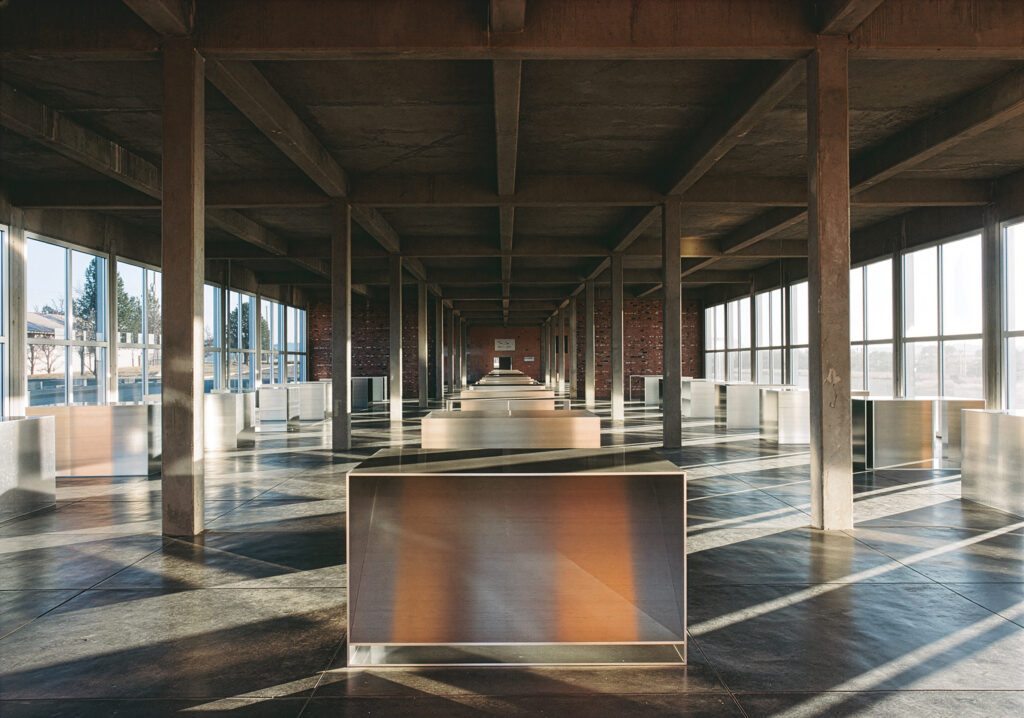
Judd’s masterwork, 100 untitled works in mill aluminum, is installed at the Chinati Foundation in two former artillery sheds. It is also a master class in tricks and exaggerations. The sheds—large concrete and brick structures with repetitive openings on either side originally designed as doors for military equipment—are long, cavernous shells. Judd replaced the doors with storefront glass, flooding the interiors with light and opening views to the surrounding landscape in the most inexpensive way possible.
Judd’s art objects (don’t call them sculpture), are modest in scale, ranging from small rectangular boxes mounted in series on walls to kitchen-island-sized forms placed individually or in groups on the floor. They express the materiality of their construction, such as plywood, steel, colored acrylic, or aluminum. At first glance, they appear as straightforward industrial fabrications, requiring precision and care but little in the way of technology or engineering.
How can these relatively small objects be satisfyingly matched with a large industrial space? Through extensive repetition, which fills the volume while reinforcing the significance of the single form—if only through its inclusion in a larger whole. For 100 untitled works in mill aluminum Judd fabricated 100 aluminum boxes of identical dimensions—41x51x72 inches—with varying internal configurations. This strategy occupies the floor plane while maintaining generous space around each unit, allowing for an ever-changing sequence of perspectives as one moves through the gaps. The low height of the boxes creates a sense of expansion of the space above them and, more importantly, preserves views to the surrounding landscape and sky.
The work is sublime in every respect. The rigorously repeated grid of the concrete beams and columns, receding in perspective, forms a dense composition overhead. Daylight—so often blocked or carefully moderated in gallery settings—cascades throughout the space, reflecting off the aluminum surfaces and the floor, colored by the progression of the solar cycle and shifting atmospheric conditions. Every element is exaggerated to remarkable effect: the immaculate austerity of the industrial space, the serial repetition of the aluminum boxes, the rhythm of the glazed openings, and the visual release toward the landscape beyond.
The piece tells a story of aesthetic dream logic, in which the beauty of machine finishes, daylight, and landscape are harmonized within industrial spaces co-opted as cathedrals for aesthetic worship and ritual. It unfolds like a fever dream that feels like an archetypal truth.
100 untitled works in mill aluminum so seamlessly integrates the constraints and advantages of its elements, both found and fabricated, that it defies expectation and becomes universally coherent. Brazenly ambitious and highly stylized, yet decidedly pragmatic in its execution, the work resonates with irrepressible ingenuity and a timeless reality. Tricks and exaggerations indeed.
That architects are fascinated by Judd is no surprise. What is surprising is when they can match his purity of aesthetic vision while also accommodating a public program. Biblioteca Vasconcelos, in the Buenavista neighborhood of Mexico City, is full of such surprises—combining conceptual rigor with expressive clarity within an articulated structure of concrete, steel, and glass set amid a lush sequence of botanical gardens.
The design team, led by Mexico City-based architect Alberto Kalach of Taller de Arquitectura X, distinguished its proposal from nearly 600 other entries by expanding and elevating the concept of a public library from a repository of books to something more akin to an ark of human knowledge. Recognizing that the jury would be wading through hundreds of schemes concerned primarily with housing books, the team introduced a counterpoint: a conventional interior library paired with an exterior “library” of plants. Multiple levels of botanical gardens and green spaces surround the ship-like building, creating an urban oasis defined by native species of the region.
Instead of relying on the brief to define their proposal, the team created a concept that improved and expanded on the original program with a narrative far more powerful and engaging.
Inside, five stories of book stacks are suspended from the roof structure in a shifting matrix of modular shelving units, with glass catwalks floating above a sunken linear atrium that serves as the primary circulation spine for the 250-meter-long megastructure. The effect is nearly hallucinatory in its dense articulation and spacious verticality. One cannot help but recognize the significant extent of fabrication and stylization of what is otherwise a common program, one whose technical requirements are quite modest and could be satisfied with little more than ample floor space and book stacks. Here, it becomes an exaggeration not just conceptually, but in the most literal sense as well.
Rationality—here akin to facts—is not the primary force at play. Of course, there are more rational (and more affordable) ways to make books accessible to the public. But would anyone notice? Architecture emerges only when it transcends rational planning and distorts reality in a poetic way that is legible as an aesthetic language. This narrative elevates knowledge while suspending it overhead like precious cargo, accessible to all. The articulated stacks display, tease, and lure visitors into a three-dimensional matrix of platforms and reading spaces, where seeing and being seen evokes the logic of Adolf Loos’s Raumplan at an institutional scale.
The industrial language of the structure is juxtaposed with elevated gardens and green spaces beyond, establishing a balance between human ingenuity and the bountiful offerings of nature—a simulacrum of the larger urban ecosystem.
This is a narrative for which fabrication, imagination, and stylization are necessary in the creation of a heightened atmosphere where knowledge is preserved for public consumption. Facts alone can’t get us there. We need exaggerations because they are the insights that alert us to the deeper truths of our culture and place.

Our aesthetic world has always been shaped by tricks and exaggerations, architecture being no exception. Most of us engage with them on a daily basis without naming or acknowledging them. Tricks tend to go uncredited because they fall through the cracks of disciplinary boundaries and often feel like a distraction from the valid work of a project. But they are needed at every turn with all available creative force.
As architects, we are taught early on to distrust exaggerations in favor of rationality, honesty, and restraint. While Judd is often described as a minimalist—a term he resisted—any critical engagement with his work tells us a different story. We find, instead, environments that are anything but minimal or restrained, aspiring instead to ecstatic aesthetic refinement at every opportunity. This is true for Mies, as well, even if by reputation we are led to believe otherwise.
If the narrative of modernism persuaded us that honesty and rationality could produce architecture, then it was an effective trick. Postmodernism, deconstructivism, and even classicism demonstrate that gimmicks make for poor tricks, and that exaggerations must be grounded in storytelling that resonates with its time and place. Today, architects must tell relevant stories if they want to exert influence within a fractured culture and what Mies might still call the “desperate confusion of our time.”


An East Austin studio rises above the rest.
Redefining Suburban Recreational Architecture

Thermal Delight in Architecture and the Continued Work of Lisa Heschong

A Watering Hole for the Ages
Cinematic drama meets fine cuisine.
Total Design for a New Era

Bruce Goff: Material Worlds
Art Institute of Chicago
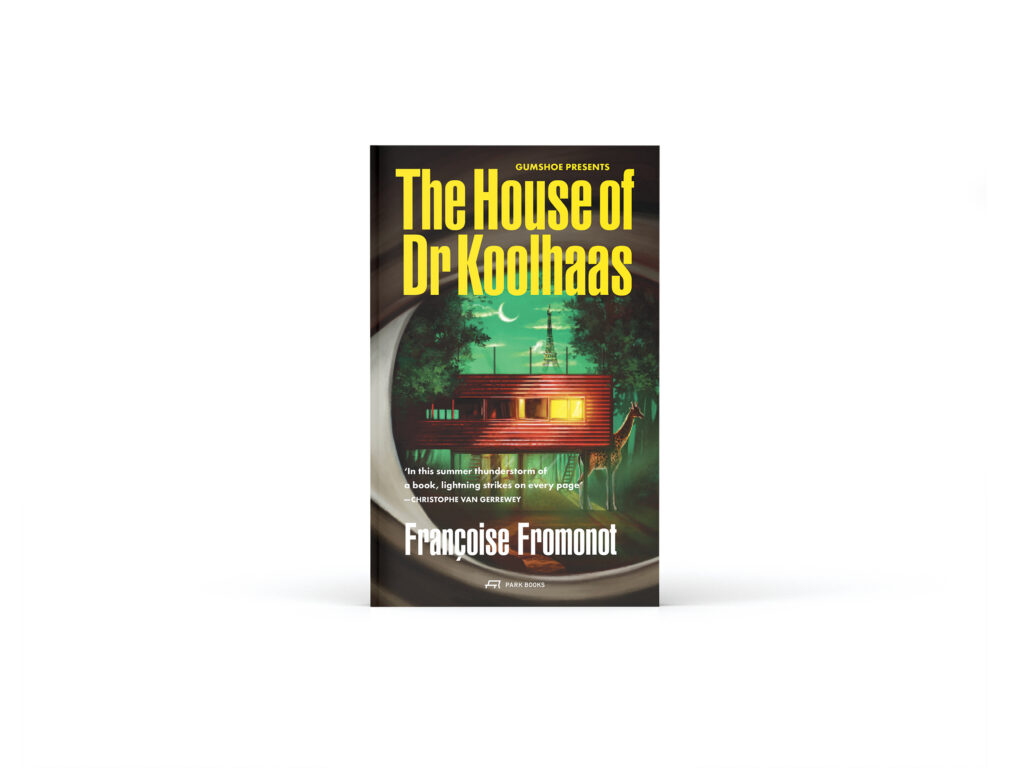
The House of Dr Koolhaas
Françoise Fromonot with editor Thomas Weaver
Park Books, 2025

The rounded edges of these products align with the growing trend toward incorporating more organic, softer shapes and curves into hospitality interiors.