Mar 17, 2026
In a profession defined by change, gathering is not optional—it is essential. It is how we learn from one another,…
Supporting Ecological Evolution in the Anthropocene
Perhaps it was the launch of Rebuild by Design—a nonprofit initiative established in 2013 by the U.S. Department of Housing and Urban Development and the Hurricane Sandy Rebuilding Task Force—that marked the beginning of the latest era of comprehensive resilience planning; or perhaps it is because we are collectively experiencing, in real time, the effects of anthropogenic climate change. Either way, institutions, governments, and private actors have increasingly been asking a shared question: How do we, as a society, adapt? This existential inquiry has elicited a general consensus around best design practices. Across climate adaptation toolkits, resilience guidelines, and vision plans, recommendations recur—to employ blue and green infrastructure, enhance flood resilience through changes to building codes, establish sustainability metrics that prioritize local and low-carbon materials, and more.
“Adaptation,” as it is commonly understood within design discourse, therefore encompasses a set of strategies intended to improve our capacity to adjust to environmental conditions altered by climate change. In this framing, certain aspects of the built environment are imagined to change: the materials of stormwater infrastructure (more green and blue, less grey); the base elevation of buildings (higher); and roadways, seawalls, and bridges (also higher). Yet this version of “adaptation” simultaneously insists on the stability of other conditions—namely, the highest and best use of private property, modes of living, and prevailing ideals regarding nature. To “adapt,” then, we are not required to adjust our behaviors or social traits, as the word’s definition might suggest; rather, we are asked only to modify the built environment in order to better control, combat, and fix the landscape.
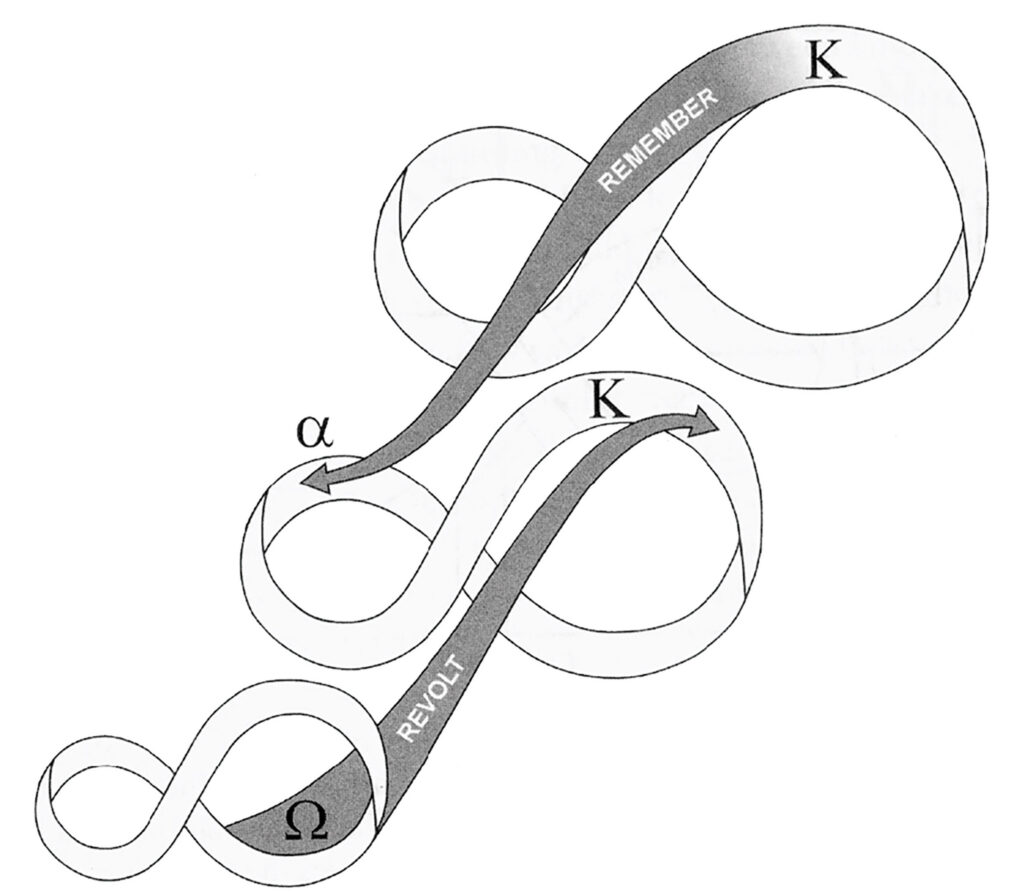
Ecosystems, however, are in a constant state of change. C. S. Holling’s well-known panarchy diagram illustrates how organizational systems move through a continuous, open-ended “adaptive” cycle of phase change—from rapid growth and exploitation, to stabilization and conservation, to disturbance and release, and finally to reorganization and flux. This adaptive cycle operates simultaneously across multiple nested scales and time frames, a condition Holling termed “panarchy.”
Consider Holling’s example of the spruce budworm in a forest ecosystem. The budworm represents a fast cycle, with a life span of a few months to a year; a tree stand represents a medium cycle, changing over many years; and an entire landscape or biome represents a slow cycle, transforming over a century. And yet these scales are deeply intertwined: The budworm population can influence the broader landscape, just as landscape-scale conditions can, in turn, impact the budworm.
Beyond the specific example of budworms and spruce forests, panarchy demonstrates that systems are interconnected across multiple scales and timeframes, and that adaptation must therefore address more than a single aspect of a cycle. Ultimately, a limited approach to adaptation amounts to a form of mitigation. Such an approach not only prevents structural changes in the environment but also forecloses possibilities for design and for novel ways of working. Can we move beyond the framework of adaptation to design environments that fundamentally enable ecological processes to evolve?
Big Fixes
Sea level rise poses an existential threat to cities and coastal regions, and coastal resilience and climate adaptation offer the promise of protecting shorelines from a range of disasters, from chronic flooding to storm surge. Projects like Living Breakwaters on Staten Island, the East Side Coastal Resiliency Project, and the Galveston Bay Park Plan promise significant protection against major flooding events. Unlike traditional “hard” coastal defenses, such as concrete seawalls, these “adaptive” infrastructures incorporate “softer” strategies—such as wetlands, dunes, and other natural habitats—intended to enhance both social and ecological value.
“Rather than separating the city from the waterfront,” architect Bjarke Ingels, founder of BIG, said of the East Side Coastal Resiliency Project in an article published on the website New York YIMBY, “we’ve designed a public realm that invites people in with new connections across the FDR, transforming flood protection into a tapestry of everyday experiences…. The result is infrastructure that not only strengthens but also enhances the city’s coastline.”
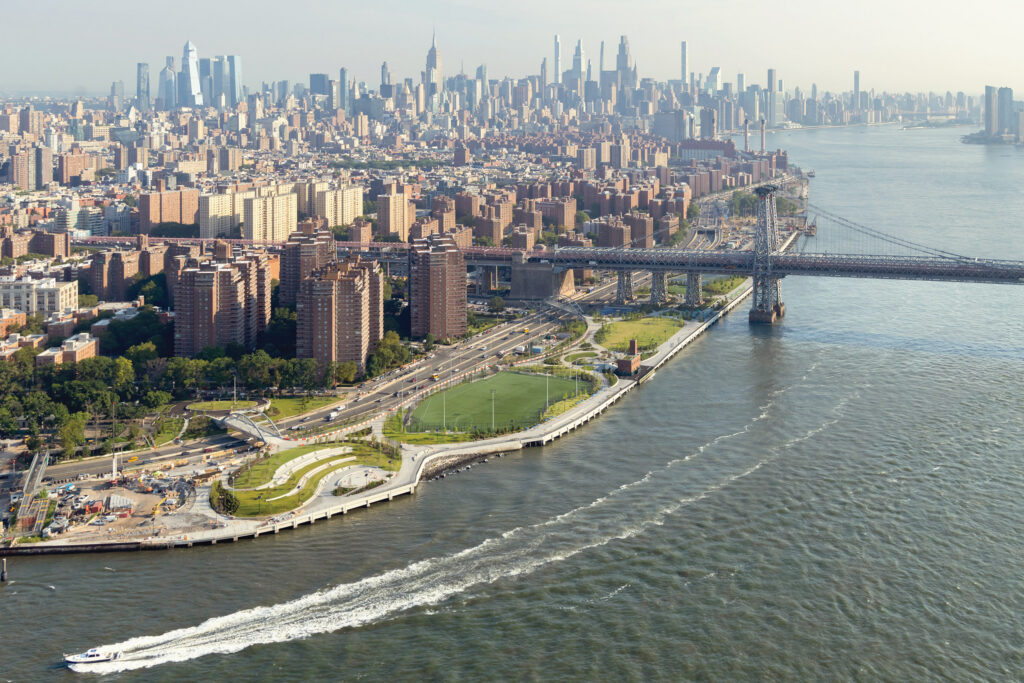
Despite their ambitious design intentions and ecological benefits, such coastal resilience projects reveal an underlying contradiction. Their primary purpose remains the stabilization and defense of the coastline, preserving existing neighborhoods, infrastructure, and patterns of development. While this line of defense is undeniably meaningful, it also frames phenomena such as erosion and flooding as problems to be fixed, rather than as inherent dynamics of coastal systems. Ironically, the resilience—or survival—of the coast is made dependent upon infrastructures that fix it in place, denying its natural tendency to move.
Big Dreams
Adaptation often disguises our desire to preserve and conserve. We cling to an idealized image of nature as we attempt to restore what has been lost. As greenfield development, sprawl, and extractive industries continue to alter the landscape, we find ourselves dreaming of what was once wild.
Once a thriving wetland ecosystem in the Florida Everglades, a patch of abandoned farmland known as the Hole-in-the-Donut had been significantly altered by fertilizer use, tilling, and intensive agriculture. By the 1970s, when the land was ultimately acquired by the surrounding Everglades National Park, it had become overrun with nonnative species and was widely regarded as a haven for weeds. Yet it was also thriving in its own way: The landscape was lush and diverse, humming with a dense population of insects and raccoons, and even home to a number of Florida panthers.
Regardless, the park viewed this weedy site as a profound threat to the historic ecosystem and, in the 1990s, initiated a massive effort to restore the original wetland conditions. To do so, the project aimed to completely remove altered soils from 6,300 acres by scraping away the topsoil with heavy machinery. The undertaking cost more than $100 million, and over nearly three decades approximately four million cubic yards of biomass have been scraped and stockpiled.
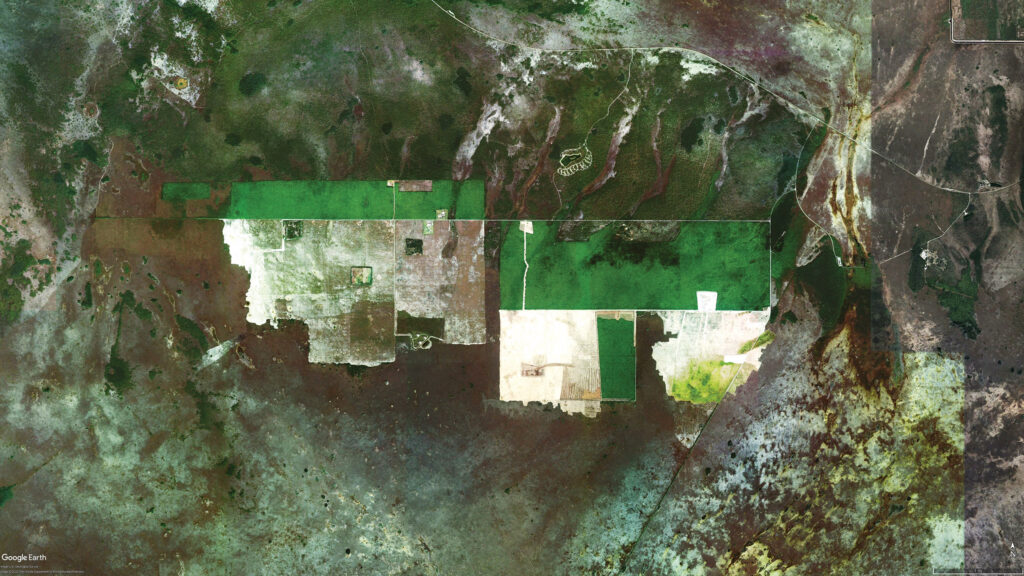
In the 2006 article “Ecological Restoration and Global Climate Change,” ecologist Richard Hobbs, a prominent critic of traditional restoration ecology, argues that “valuing the past when the past is not an accurate indicator for the future may fulfill a nostalgic need but may ultimately be counterproductive in terms of achieving realistic and lasting restoration outcomes.” Restoring the Hole-in-the-Donut eliminated valuable existing ecosystem services and required the intensive use of machinery and fossil fuels. Meanwhile, the targeted “invasive” species persist. Even as we continue to dream of past wilderness, in environments that have been dramatically altered by humans, is it possible—or even practical—to rewind the clock and reverse so many entangled biological and geological processes?
Wilderness, as William Cronon reminds us in his essay “The Trouble with Wilderness; or, Getting Back to the Wrong Nature,” is itself an idea. “[It] hides its unnaturalness behind a mask that is all the more beguiling because it seems so natural. As we gaze into the mirror it holds up for us, we too easily imagine that what we behold is Nature when in fact we see the reflection of our own unexamined longings and desires.” As we propose new solutions to the changing climate, we should continue to reflect on what adaptation is really revealing.
A Lesson from the Land
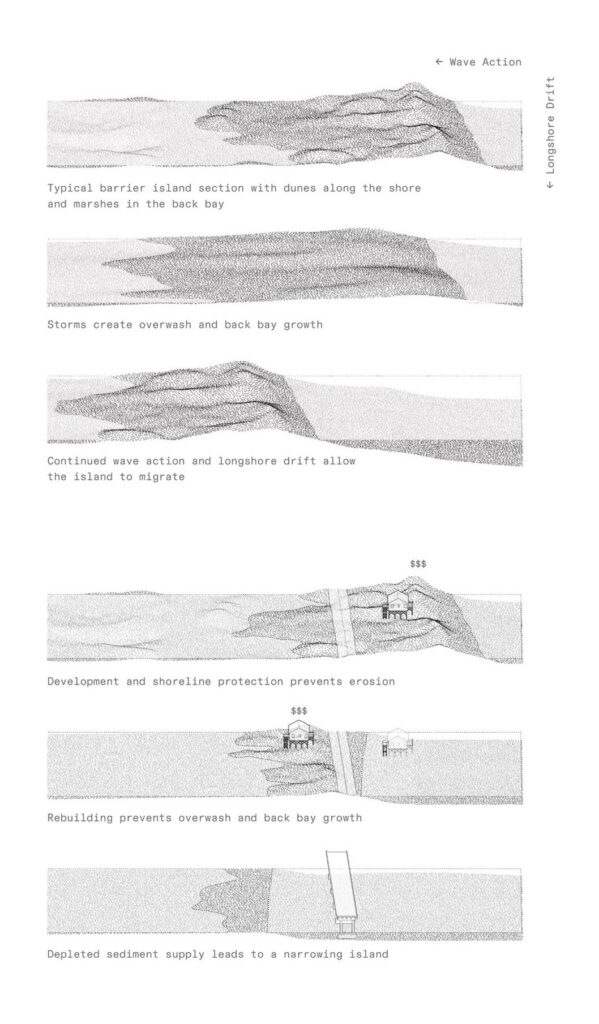
Erosion is often understood simply as the loss of land. Nowhere is this perception more evident than on the barrier islands of the Eastern Seaboard, from Maine to Texas, where coastal property is constantly threatened by erosive forces. In these communities, the fixed metes and bounds of property lines defy a constantly shifting ground. Beach houses, roads, and bridges are reinforced and rebuilt in an effort to withstand erosion, while seawalls and bulkheads are constructed to fix the land in place. Yet, as coastal geologist Orrin Pilkey observed in the book The Beaches Are Moving: The Drowning of America’s Shoreline, islands exist in perpetual motion, driven by the “endless interplay of the sea.”
Barrier islands are highly mobile landforms, migrating at rates of up to 30 feet per year; in Texas, the average rate of shoreline retreat is approximately four to six feet annually. It is only when barrier islands are parcelized and fixed in place that erosion becomes framed as an adversary. New infrastructure is planned to defend the coast and stabilize the shoreline, but these interventions end up starving the island of sediment, ultimately leading to further land loss.
By relinquishing the shoreline and allowing it to move instead, the island can easily adapt. Through sediment transfer and land migration, erosion on one side of the island becomes accretion on the other. As storm waves and rising seas erode the beachfront, sediment overwashes the island and accumulates along its backside. This is redistribution, not loss. When coastal barriers are removed, we invite the island’s slow, continuous migration—a natural process that enables the island to roll rather than drown. Coastal design, then, can move beyond resilience, defense, and preservation to work with the redistributive forces of sediment, harnessing the movement of land rather than resisting it.
Stepping Back
Gravel Silos is a five-acre park that extends four miles of the Buffalo Bayou Partnership’s extensive linear bike and pedestrian network along Buffalo Bayou in Houston’s East End. The site was once used to store shell and aggregate dredged from Galveston Bay; barges would unload material at the bayou’s edge, where it was stored in massive concrete silos. An existing trail runs atop a bulkhead wall constructed in the 1960s. Today, that wall is full of voids, and within them is a novel collection of willows and cypress trees, ferns and moss, oyster shells, gravel, and rusted sheet metal.

Even with ground penetrating radar (GPR) and detailed structural analysis, the exact condition of the wall remains a mystery. Its future is equally uncertain, as it is impossible to determine how long it will stand or what loads it was originally designed to bear. But it will fall, eventually—it is only a matter of time.
As a result of urban development upstream along the bayou, both the volume and flow of water moving through the channel have increased. With each storm, the banks shift and scour, flushing sediment downstream to Galveston Bay and leaving behind steep slopes that are gradually eroded and flattened by gravity. Through this ongoing cycle, the bayou continually carves a new form, transforming itself into a wider river with gentle banks where plants can take root.
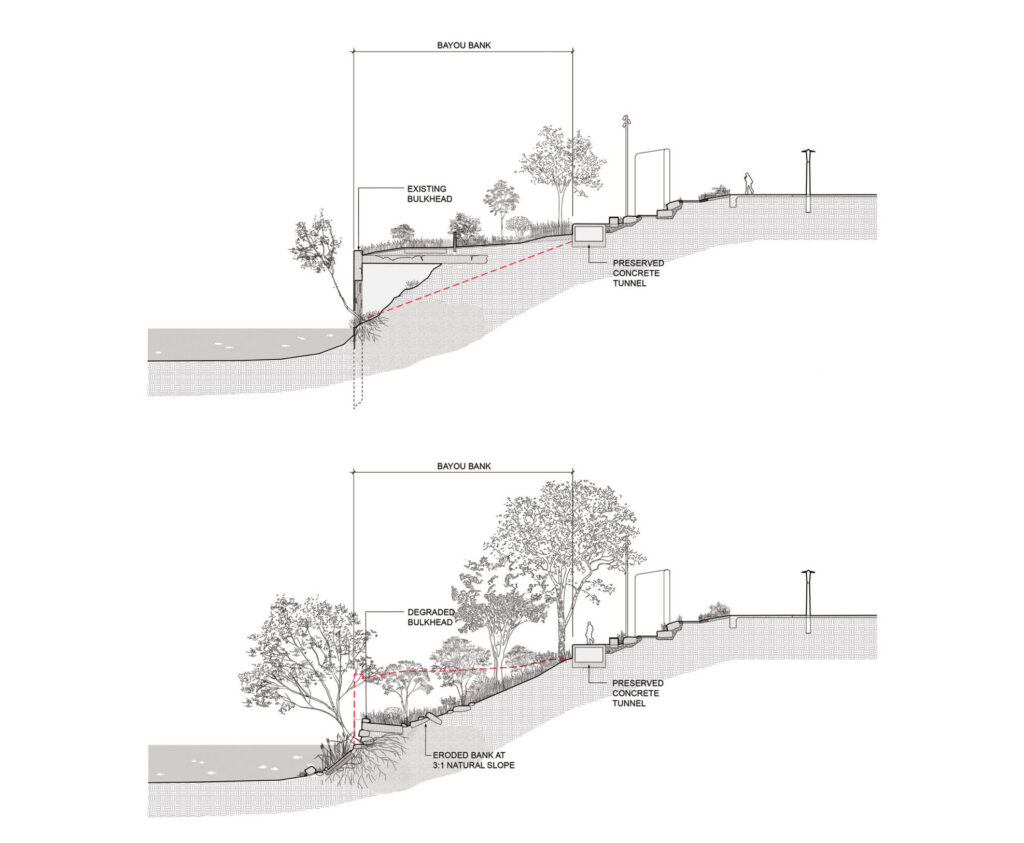
Rather than spending millions of dollars and years navigating the permitting process to remove and replace the existing wall—only to face the same risks once again—the proposal deliberately chooses to do less, and to step back. The trail is relocated to the upper bank of Buffalo Bayou, beyond the floodplain. In doing so, the design allows the bayou to move. Land along the existing bulkhead wall is ceded, and rather than resisting the flow of water, the wall is left to remain and gradually degrade in place, creating space for willows, cottonwoods, and cypress to grow.
A Lesson from Plants
The salt marshes of the upper Texas coast are shrinking. Under natural conditions, salt marshes—like barrier islands—migrate inland as sea levels rise, relying on shallow, gradual slopes to move and shift over time. Coastal infrastructures intended to combat sea level rise, erosion, flooding, and storm surge, however, disrupt this process by introducing steep, uneven surfaces. In doing so, they constrict the marsh’s territory. The marsh has nowhere to go, caught between a wall and a rising sea.
Atop the wall along the south jetty of Galveston Island’s East Beach stands one of the northernmost established stands of black mangroves in Texas. Here, within a landscape that has been altered and disturbed, black mangroves (Avicennia germinans) are actively growing and adapting. Historically, black mangroves did not extend north of Matagorda Bay, constrained by frequent hard freezes. Today, however, a warming climate has enabled their expansion farther north—a process referred to as tropicalization—and they are now well established in Galveston.
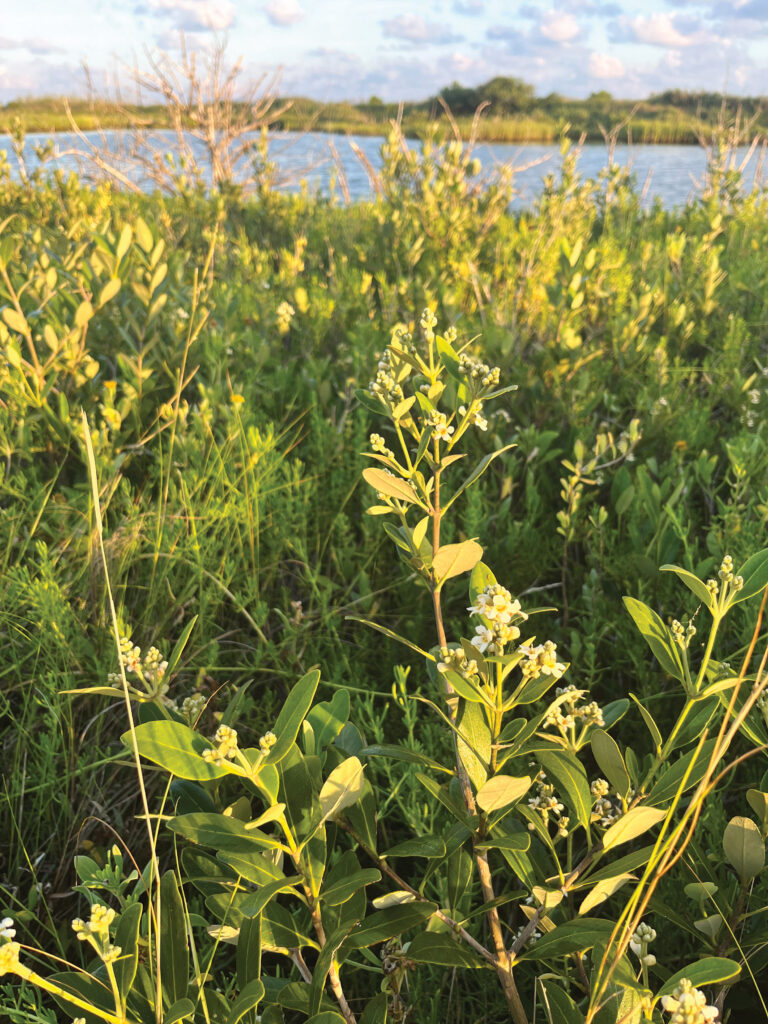
Within the East Beach marsh, which is dominated by smooth cordgrass (Spartina alterniflora), old granite blocks and riprap inhibit the marsh’s inland migration while simultaneously creating ideal conditions for black mangroves. The steep, rocky mounds are exposed to salt spray that few other species can tolerate, allowing black mangroves to thrive with little competition.
The tropicalization of black mangroves combined with the shrinking native salt marsh challenges the notion of native ecologies. Though new mangrove forests along the Gulf of Mexico could significantly increase carbon sequestration, they would also establish different plant and animal assemblages causing dramatic shifts in the ecosystem. The strange colonization of mangroves on old rock jetties defies our understanding of historic ecology. Changes to the ecosystem cannot be stopped or controlled, as the adaptation of one species sets off multiple chain reactions. Some of these effects will threaten current conditions while simultaneously giving way to novel ones that we cannot yet assess.
Taking Time
Where there was once a large academic lawn, next to the James Turrell Skyspace at Rice University, now sits an experimental patch of prairie grasses and wildflowers. The project, known as Prairie Plots, is not an attempt to restore a native ecology. Rather, it is a trial landscape that embraces novelty, messiness, and hybridity—part prairie, part weedy lawn, part garden.
Transforming this pristine academic lawn into a prairie landscape uses time as a primary design medium, slowly altering soils and cultivating plant diversity across many cycles and seasons. Over several years of cover-crop planting and monitoring, the site’s soils—long shaped by agriculture, construction, and development—were transformed from dense “gumbo” clays into living, loamy soil. The resulting landscape does not replicate the region’s historic Gulf Coast prairie; instead, it emerges as a hybrid landscape, composed of both intentional plantings and spontaneous species.
Still, the site showcases a wide range of ecosystem services. Compared with other open spaces on campus, it supports a greater number of species and a higher level of biodiversity, and its soils host a larger community of microorganisms. The site has also served as a testing ground for the university to conduct prescribed burns as a form of land management.

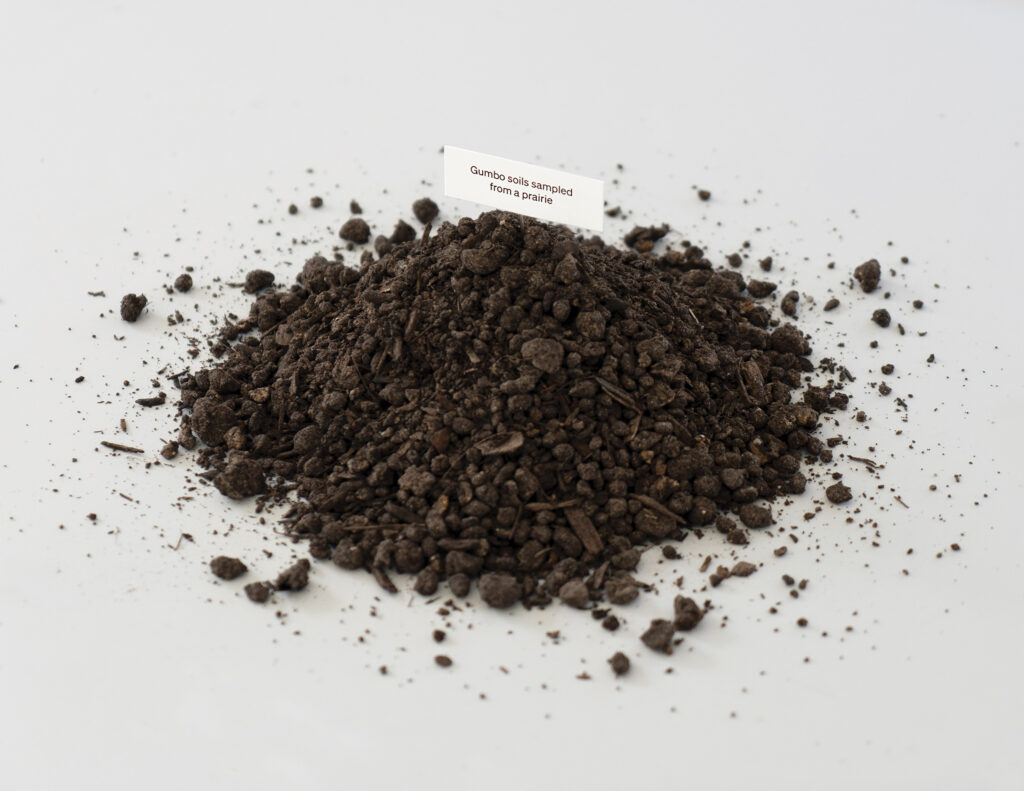
Prairie Plots opposes the static ideal of a native prairie ecology. Instead, it is an evolving landscape that relies on a community of people to steward, manage, and work with it. By using fewer material resources but more time, the plots respond to changing environmental conditions and to the people who care for them, adapting in tandem.
A narrow view of adaptation reveals our collective tendency to fix, stabilize, and preserve. This limited approach inhibits ecological evolution and places us on a path toward obsolescence, where, despite our best intentions, we continue to contribute to the destruction of our environment. Moving beyond this framework, however, demands a shift in perspective—from resisting dynamic forces to working with them. Of course, doing less to control the environment and more to allow for its transformation presents an inherent design challenge, one that will produce complex changes and unavoidable trade-offs, but that also invites the progression of ecological processes toward a novel future.
Isaac Stein is a landscape architect and architect from the Gulf Coast. He is cofounder and design principal of Dept.
Maggie Tsang is a landscape architect and urbanist. She is cofounder and managing principal of Dept. and assistant professor at Rice School of Architecture.

A Home Designed for the Decades
An Argument for Creative Reuse Over Preservation
A Historic Structure Updated for Next-Gen Commerce
Expanding a 1930s Bungalow for a Modern Family
Evolving the Profession for a Changing World
A Houston Garage Remade as a Culinary Destination
Adaptive Reuse at Pullman Market
Building With Fruit Waste Matter

Oblique Experiments
Igor Siddiqui
Applied Research & Design, 2025
The Type V City: Codifying Material Inequity in Urban America
Jeana Ripple
University of Texas Press, 2025

These new LED lighting fixtures for spaces from tabletops to stairwells offer flexible illumination for residential and commercial spaces.