Dec 17, 2025
As I reflect on my year serving as president of the Texas Society of Architects, I am filled with gratitude—for…

A bustling community center for Northwest Austin
Legendary jazz drummer and composer Max Roach, at the zenith of his career, described his drums as “my sanctuary—they keep me grounded and connected to the world.” What does the word sanctuary mean to you? A place of refuge or safety? A haven away from the whirling bluster of daily life? It’s a word whose meaning is found at that elusive crossroads between the universal and personal—more often felt than satisfyingly described.’
Shalom Austin prides itself as “the convener of Jewish life in Central Texas.” It is a sanctuary of community, culture, and spirituality for members of Austin’s Jewish community and many others who choose to spend time there. Yet the facilities weren’t always suited to support its ever-growing and multigenerational membership. Its founding dates to 1996, when Michael and Susan Dell donated a hilly 40-acre plot in Northwest Austin to the organizations that would one day evolve into Shalom Austin. Then known as the Dell Jewish Community Campus, its loose grouping of several multiuse structures housed community facilities like an education center and a modest theater, hosted much-loved annual summer camps, and provided a workspace for Shalom Austin’s staff.
As Austin grew exponentially through the early aughts, Shalom Austin’s leadership recognized the need for change and engaged The Beck Group to guide its evolution into today’s Dell Jewish Community Center (JCC), with an eye toward continued growth. Andy Kennedy, AIA, design director for Beck’s Austin office, anchored this reinvention in the center’s notable completion of the community and fitness building.


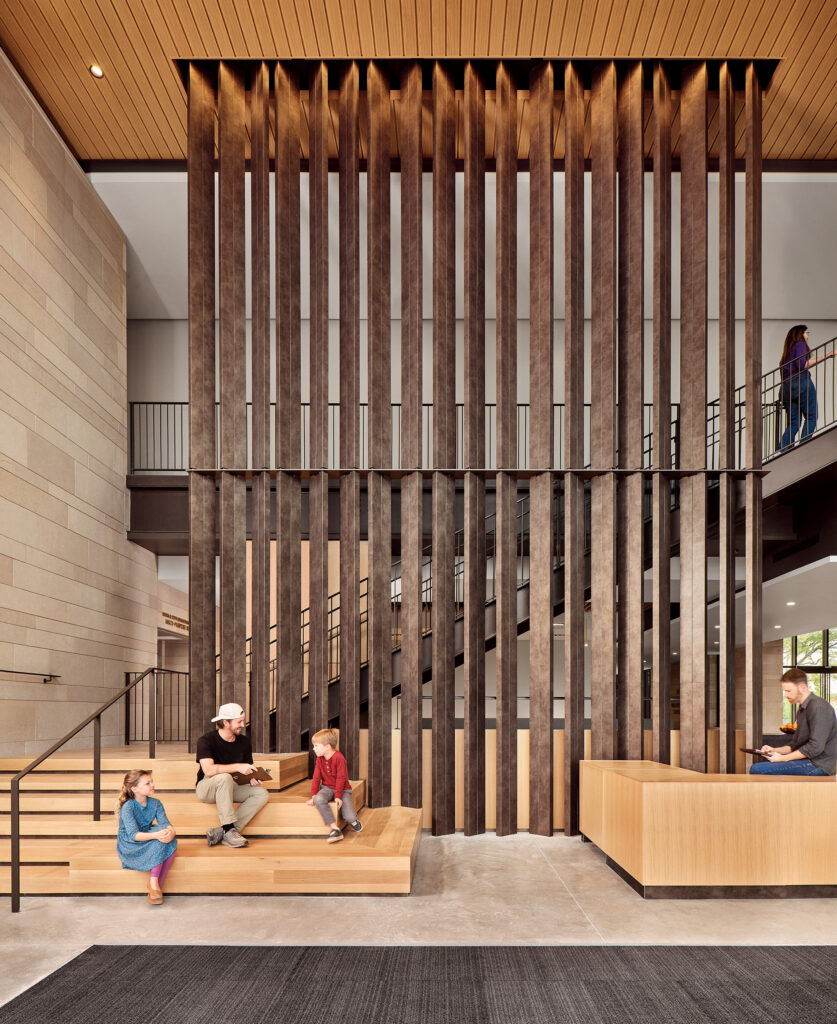
Beneath a broad, elegant roof, the monumental new limestone and glass community hub was completed in 2023 and serves as a bustling gateway into the rest of the Dell JCC. As part of the last phase in a campus-wide, multi-project renovation, the building houses a new coffee shop, multipurpose meeting rooms, upgraded fitness facilities, and Shalom Austin’s offices. At 40,000 sf, the construction unites earlier renovations under one roof and will welcome many more visitors and community members well into the future. The new building is linked to nearly a mile of trails on the grounds and takes advantage of the site’s rare natural beauty, wildlife habitats, and meditation garden.
Accommodating growth was a key driver of Beck’s design. And while cozy interiors aren’t typical of such a large building, Shalom Austin CEO Rabbi Daniel Septimus calls the latest project the center’s “living room.” It is an apt description. Material choices and modular elements collaborate to create a space equal parts comforting and grand. The ceiling’s warm-hued and sustainably sourced wood slats evoke the abstracted form of a sukkah, the temporary dwelling typically assembled from branches for the Jewish festival of Sukkot, which often carries associations of interdependence and interconnection.
Kennedy, knowing that the serenity of sanctuary is often bolstered, not hampered, by transparency, made a point to celebrate flow and connection. The coarse limestone block walls and black-steel-framed floor-to-ceiling windows create a seamless flow from outside to in—from the reception and café area into the living room. Indeed, Septimus and Kennedy wished to “invite Austin in” to the Dell JCC. At the living room’s far end sits a waist-high stage where, during my visit, an acoustic guitarist strummed and sang to the afternoon crowd.
When a program calls for privacy and openness to share a single space, modularity is the silver bullet. As such, the walls of the building’s numerous multipurpose rooms, like those adjoining the living room, are more akin to operable walls or dividers and can transform a room according to need. The spare concrete room in the renovated original community building holds a black box theater and is deceptively enormous but subdivided by partition after partition. No matter the need, the building can accommodate it.


Beyond accessibility, the center fosters community connection through visibility. Beck optimized sightlines to promote openness and interaction throughout the building, from the long arterial hallway beginning at the entrance to the Shalom Austin offices located atop the living room. The plan is laid out in succeeding spheres, from public to increasingly private. Down that arterial hallway, just past the reception area and living room, is the expanded and expansive two-story fitness center.
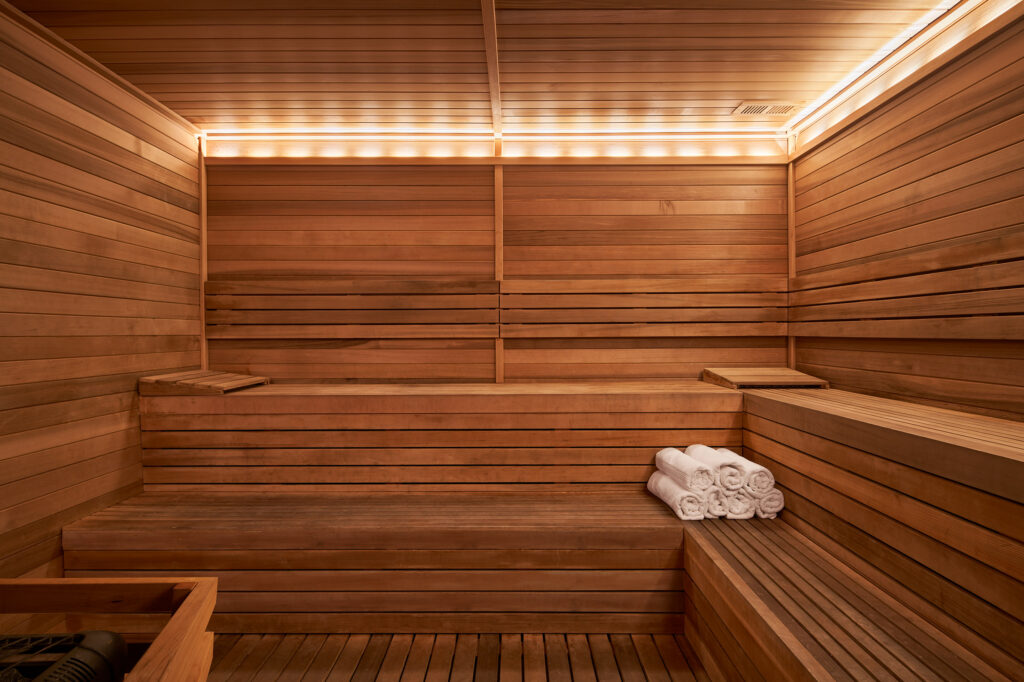
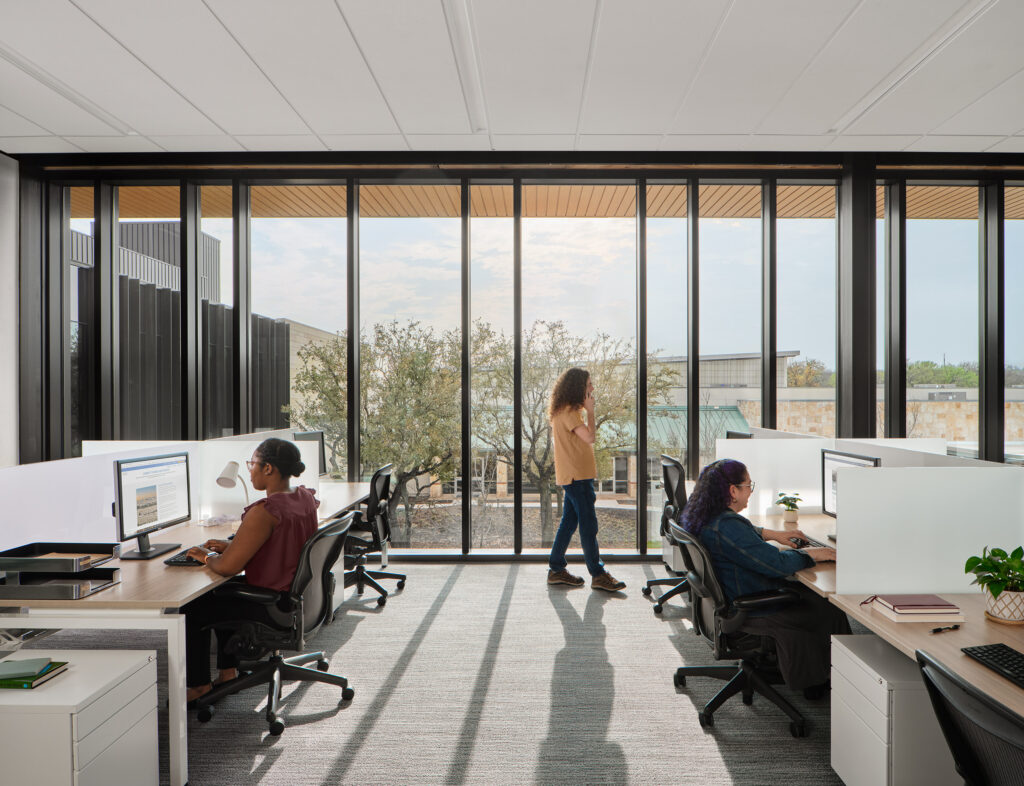
The athletic facilities are major draws for residents of the surrounding neighborhoods, who can access the center with a membership. Visible just under the fitness center’s second story is the outdoor aquatics complex, composed of an expanded pool, wood-slat changing stations, and a subdued concessions/equipment storage building. Further past the fitness center and hallway to access the original community building are the locker rooms, each including a small lounge and direct pool access. Both also contain saunas, which take the wooden textures of the center’s living room ceiling and distill them into a contained environment of pure warmth, providing a respite and contrast from the locker rooms’ emphasis on monumental stonework.
Finally, at the central hub hallway’s end, doors open to the simultaneously most expansive and most interior milieu. The .87-mile trail network weaves around the center’s grounds, where the ambiance of wind blowing through trees and hanging chimes intermingles with the splashes of families swimming in the pool around a corner. Following the path past a community garden and chicken coop leads to the tranquility of the meditation garden, at once secluded from and inextricably part of the rest of the world and this unique community.
That dual sensation of personal sanctuary and connection to the social web, felt at in the chest and mind alike, is present across the entirety of the Dell Jewish Community Center. Andy Kennedy and The Beck Group pinpointed it and, to varying degrees, honed every element of the new designs and renovations to elicit this feeling in visitors, guests, and Shalom Austin employees and community members. When we are aware of ourselves as active participants in humanity, we operate contextually, rather than singularly. Skillful architectural design and construction can spark that awareness, providing environs to commune with one’s own individuality alongside reminders of the other individuals upon whom you depend. Wherever you go, whichever projects you design, or whatever buildings you enter, we would all do well to remember our contexts and our communities.

Housing Policy and the Quest for Shelter
A new model for neonatal care
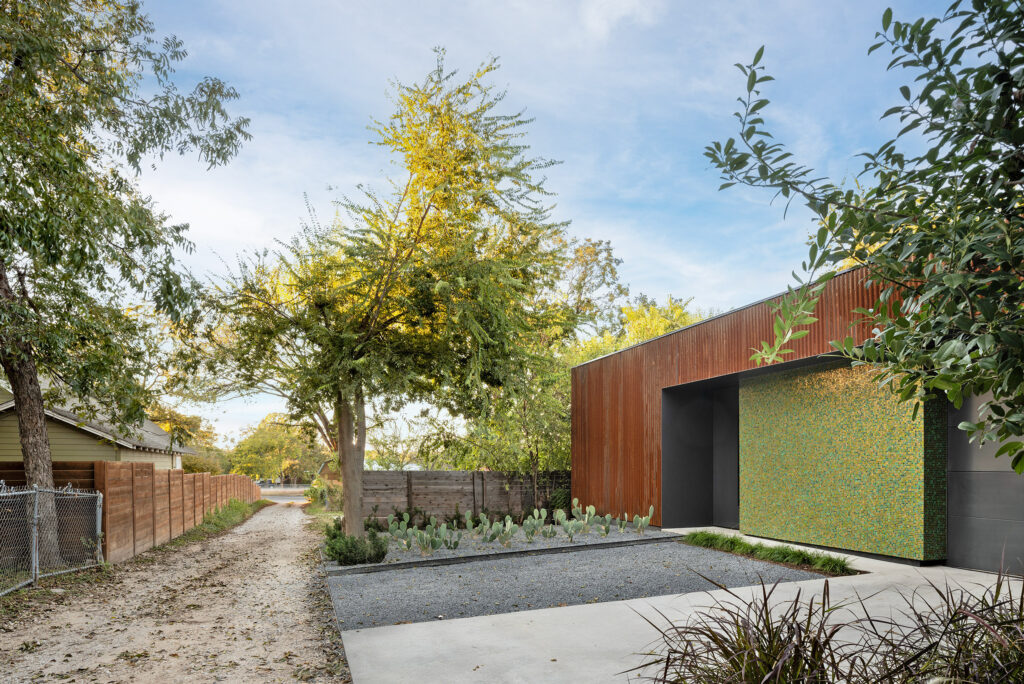
Austin’s Stealth House defies convention.
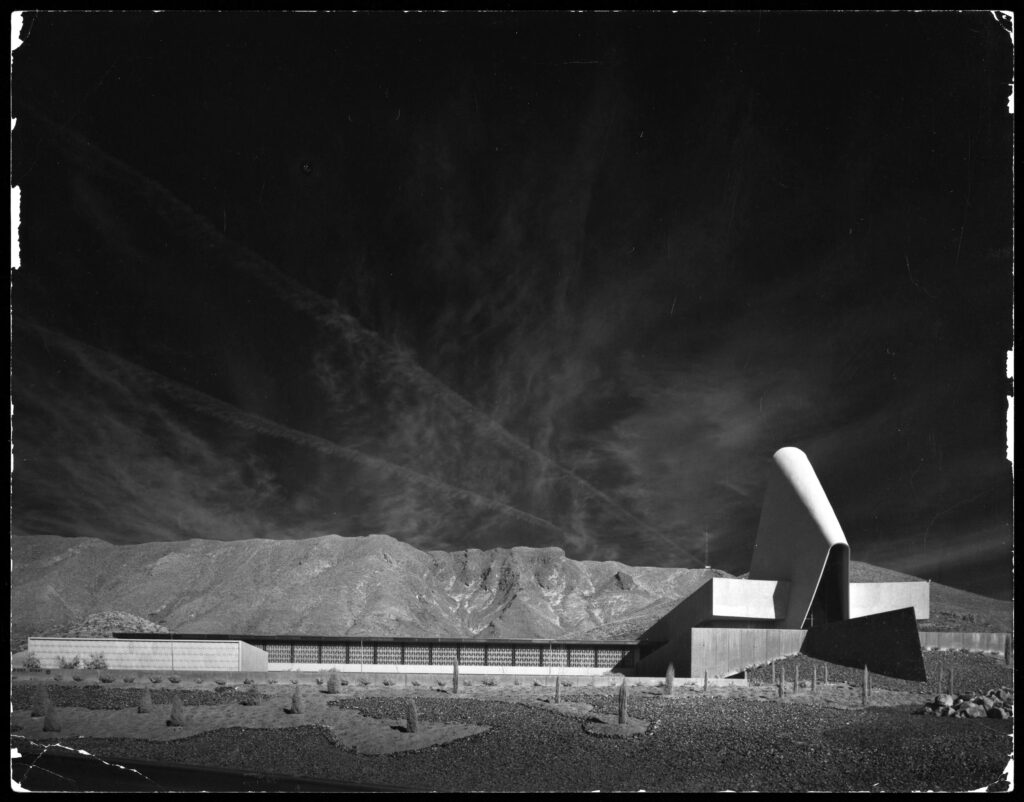
The making of El Paso’s Temple Mount Sinai

Exploring new possibilities for green burial
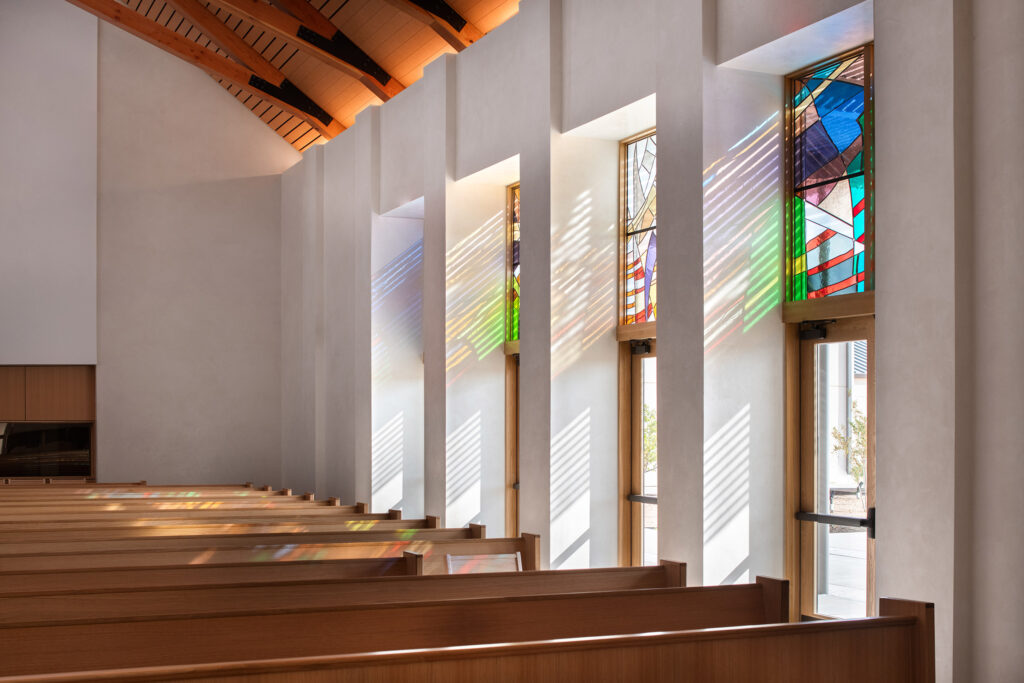
A new home for a West Texas church
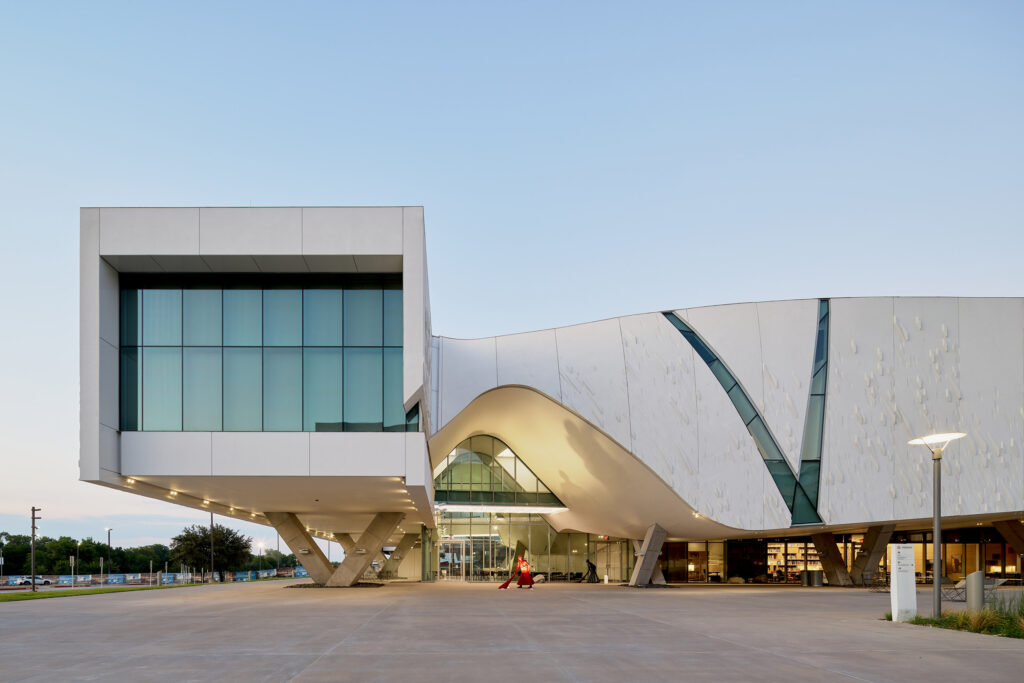
The first phase of UT Dallas’s new arts complex revealed
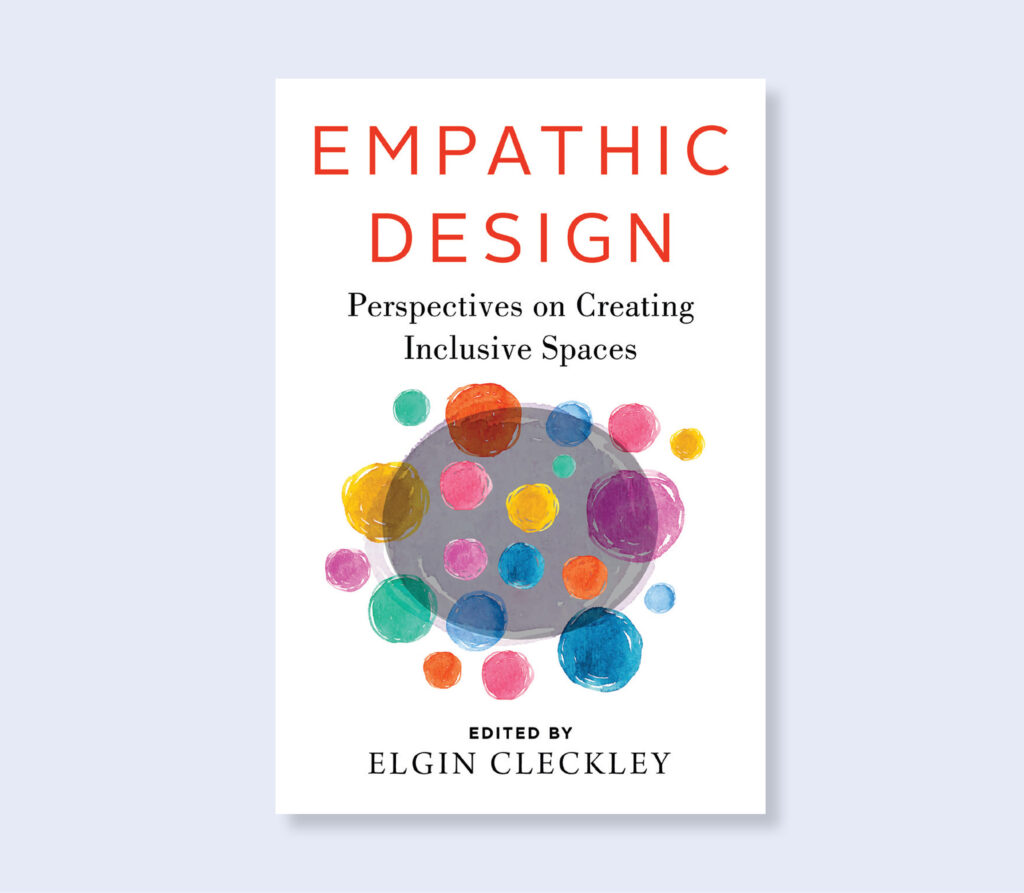
Empathic Design: Perspectives on Creating Inclusive Spaces
Elgin Cleckley, NOMA
Island Press, 2024

Creating the Regenerative School
Alan Ford, FAIA, Kate Mraw, and Besty del Monte, FAIA
Oro Editions, 2024