Jul 28, 2025
Design for a Changing Climate

Our brains are constantly trying to make sense of the cacophony around us…. We arrange things into recognizable arrays of meaning and fit unknowns into previously categorized groupings. This is a survival mechanism from way back in our existence, and we have become very good at ‘reading’ our surroundings. Indeed, we are so good at this, that we will persist in seeing meaning where there is none. —Karl Aspelund in The Design Process
A pen leaves a single mark on a page, one yet to have meaning. As more lines are drawn, a recognizable pattern emerges. The pen keeps moving, rendering an idea that was once invisible, even to the person controlling the pen. That is the power of intuition.
An important part of the design process, intuition is the subconscious process our brain uses to understand the world without rational, conscious thinking. It is somewhat reactionary and, in many cases, invisible to our perception. When we act on intuition, our brains reference an archive of experiences, extract relevant information, and guide us to solutions that feel instinctively right. Many factors determine how our intuition evolves: the type of information we’ve been exposed to, our personal experiences, our geographic upbringing, our focus in the moment, and, as Amber Alhadeff describes in “The Power of Hunger,” even how hungry we are at any given time. Thus, intuition can be both held hostage by the fallibility of our senses and a source of profound creativity.
In design, intuition gives us the sense that something is right or wrong, or indicates that a solution lies in one direction or another. It quickens architectural problem-solving by referencing experience to shortcut an otherwise laborious rational dialogue. This is why it is so valuable—it’s the opposite of “reinventing the wheel” and can be usefully thought of as a palimpsest of notable experiences written on the folds of our brain.
If our intuition informs our design decisions and is built on our experiences, we should verify that our experiences correctly describe the environment in which we design. If our intuition is influenced by what is “seemingly” true but not “actually” true, the outcome will be flawed.
Architect Juhani Pallasmaa argues in The Eyes of the Skin that “elements of architecture are not visual units or gestalt; they are encounters, confrontations that interact with memory.” Our senses are the bridge to our understanding of reality. However, this bridge needn’t be built through direct experience alone. Some elements of reality are either invisible to or distorted by our direct senses. Below, we will explore how to augment our direct experience with measured, objective site and climate data to seek greater accuracy in our perception of reality.
Climate data offers a valuable opportunity to deepen our understanding of how well-informed intuition enhances design. There is no building in existence that is not, in some way, intimately connected to climate. It is arguably one of the principal components of our design zeitgeist. So, the process of gathering and mapping climate data gives us the means to understand and make obvious important lessons learned—lessons that will carry us through subsequent design efforts. Climate data is useful because it is robust, objective, and accessible. It serves as a fact check on our intuition, which is otherwise shaped by subjective experience. A comprehensive site analysis is even more important when designing in unfamiliar regions.
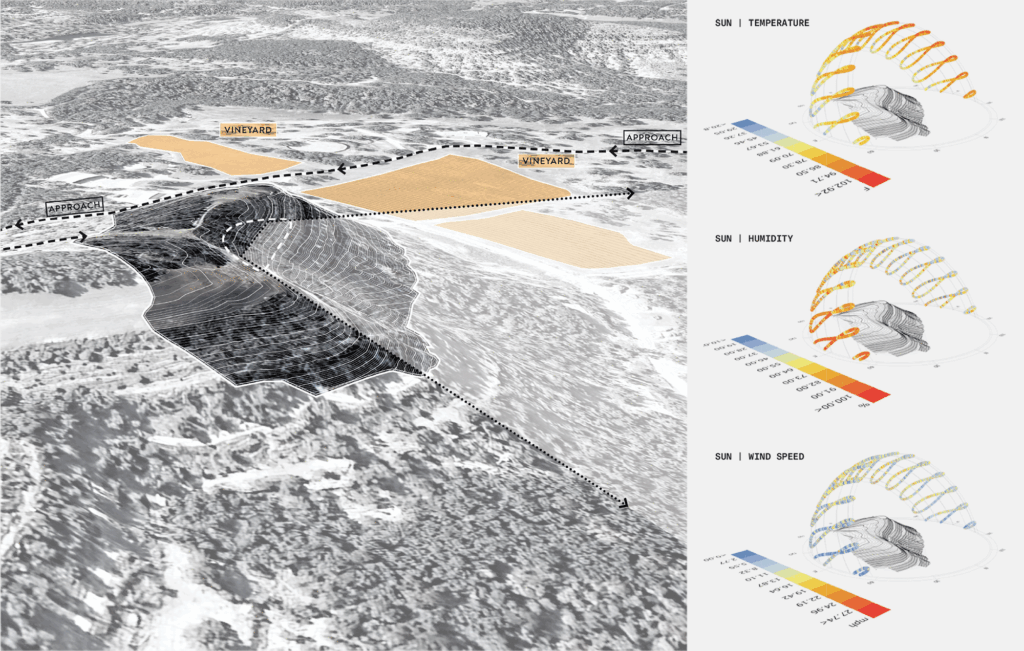
A thoughtful site analysis should:
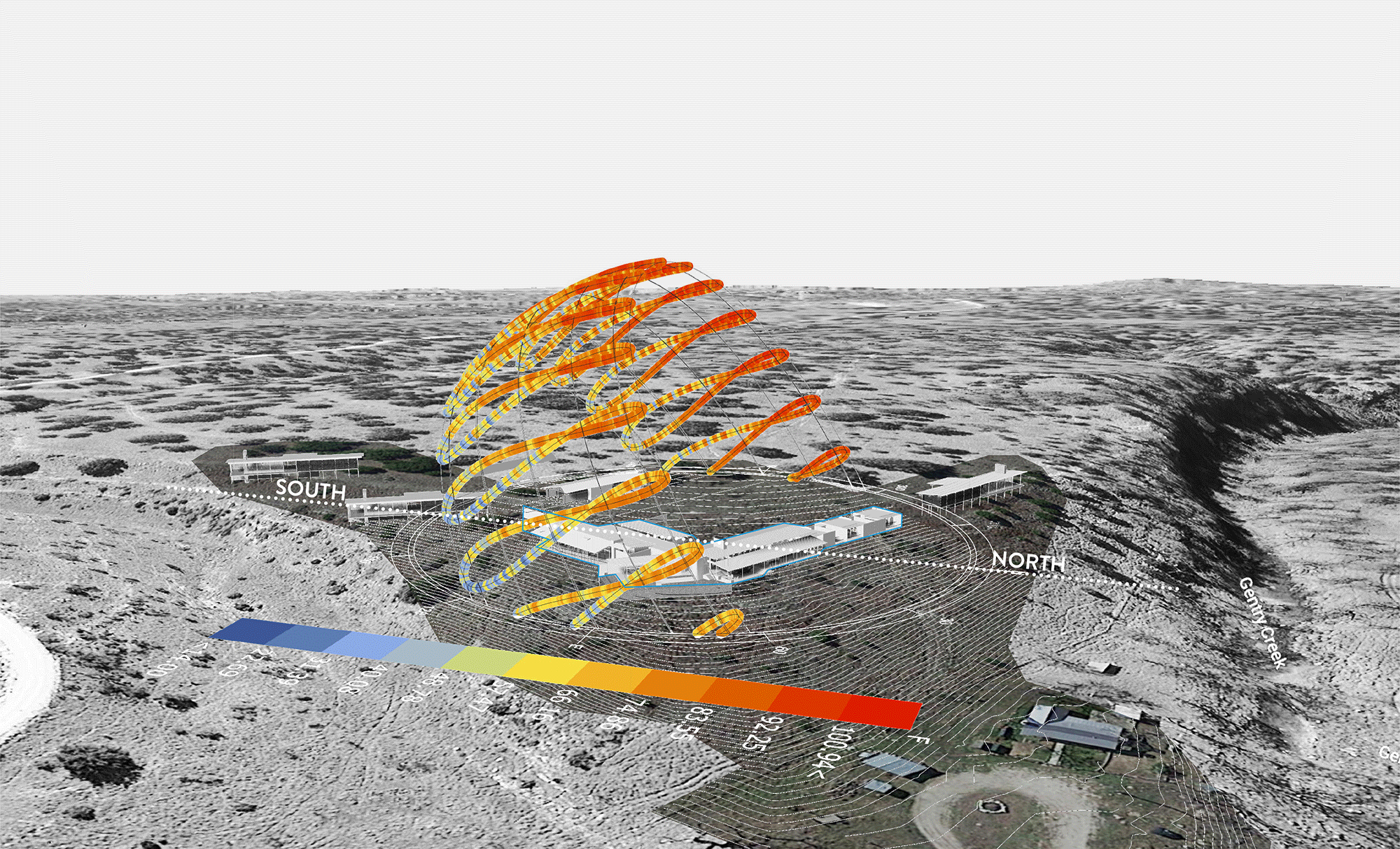
If we accept these metrics, we must recognize that merely overlaying winter and summer sun paths on a plan or drawing blue and red wavy lines to identify wind patterns is completely insufficient. They do not manifest keener intuition. Similarly, showing that the sun rises in the east and sets in the west doesn’t further our understanding of the sun’s importance in architectural design. These types of analyses are, instead, lip service to an otherwise vast source of profound insights. They are entirely insufficient and unfortunately all too common.
Fortunately, we have an enormous body of data from which we can extract truly meaningful insights about climate. This data is freely available as EnergyPlus Weather (.epw) files. So, our muse is accessible and robust. We need but find the tools to utilize it. Here, we are fortunate as well. Parametric modeling software built for this purpose is available at low cost. Grasshopper, now integral to Rhinoceros modeling software, gives us the ability through free plugins to evaluate data from .epw files and produce legible graphic outputs that, with a bit of work, can be beautiful.
Within Rhino, Grasshopper runs plugins like Ladybug and Honeybee, powerful tools for climate and building analysis. The availability and power of these tools means that if we claim to take seriously the responsibility of designing sensitively to climate, then we have a responsibility to use them. We cannot be satisfied with red and blue wavy lines, summer and winter solstice arcs, or clouds with raindrops.
Let me offer an example, a telling one that illustrates the potency of critically evaluating even the ideas we hold with high confidence. Below is a series of wind rose diagrams using climate data for Death Valley, California. A wind rose diagram uses a polar grid representing cardinal directions. Highlighted areas indicate values that increase in frequency further from the grid’s center, colored to represent values according to a legend. The first wind rose illustrates wind direction (coordinate grid), frequency (distance from center), and temperature during that hour (color).
From this diagram, we can conclude that wind primarily comes from the northwest and southeast, is more frequent from the northwest, and is hotter from the southeast. For those familiar with Death Valley’s record temperatures, it is no surprise that the average temperature tops out at 125 degrees Fahrenheit.
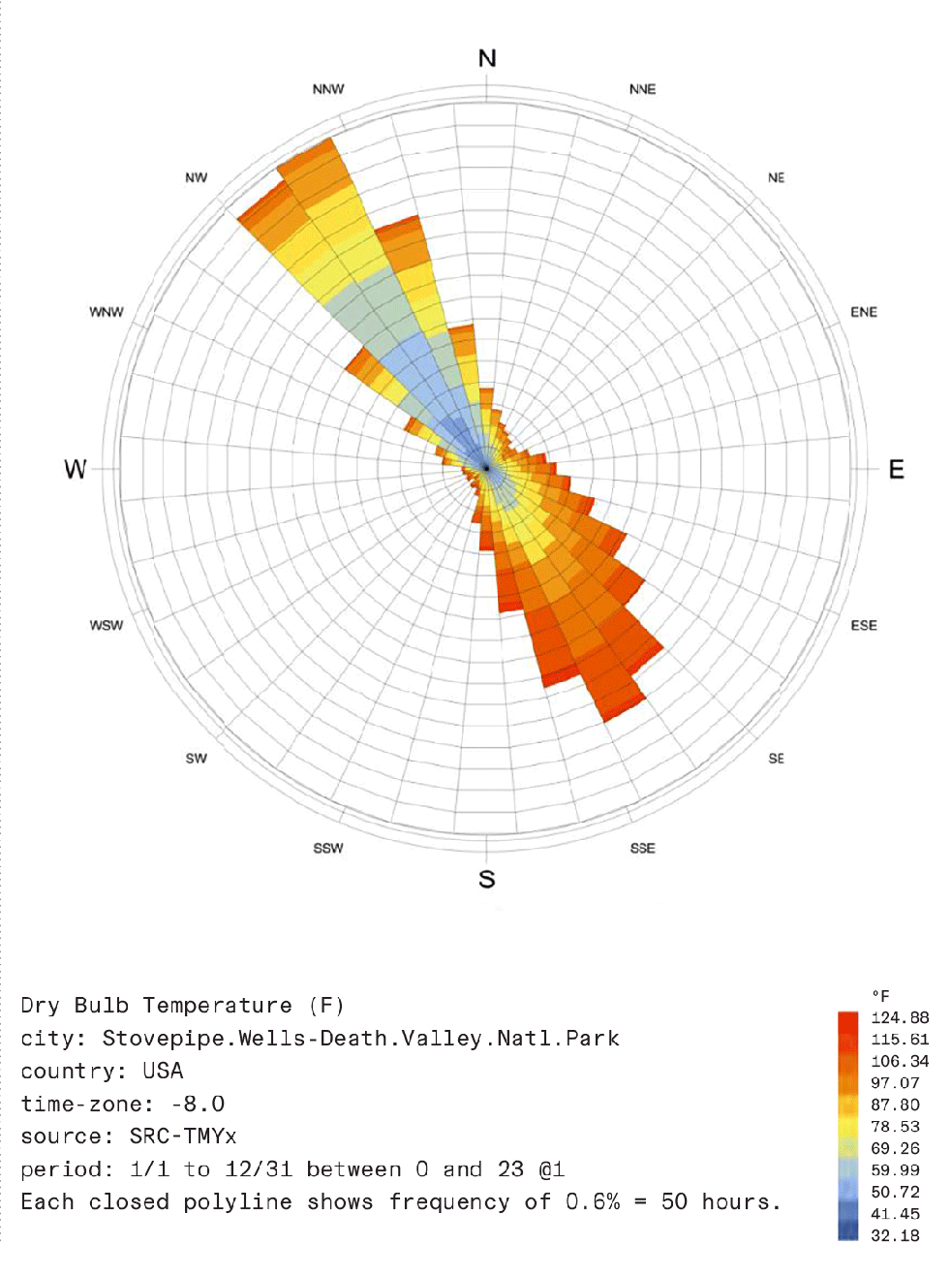
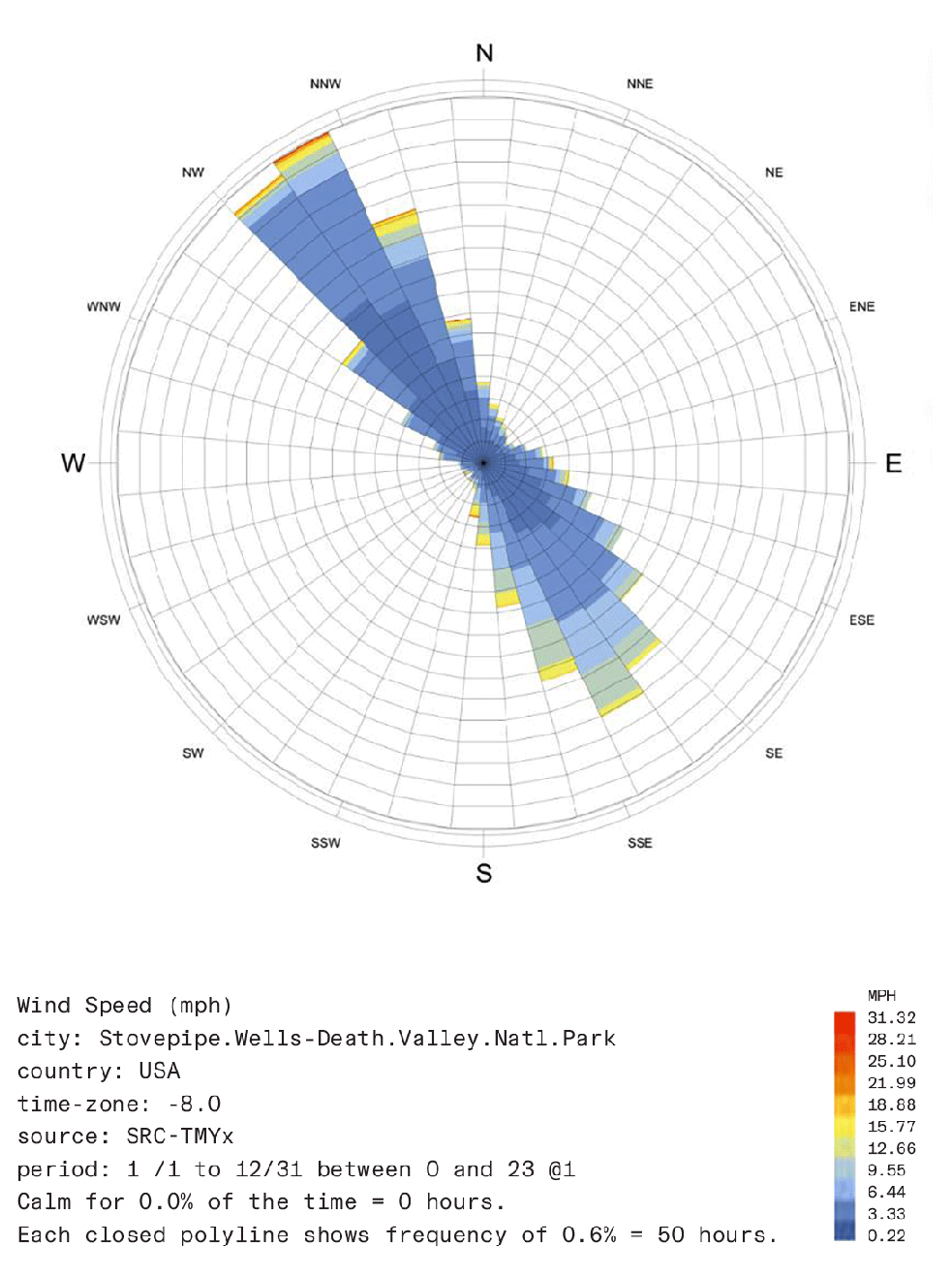
What surprised me was mapping wind speed instead of temperature. Having visited many mountainous deserts tortured by incessant high winds, but never having visited Death Valley, I presumed it was frequently windy. As it turns out, that’s not the case. A significant portion of the wind rose is blue, indicating lower wind speeds. When we remove data for wind speeds over 10 mph, we see very little change in the scale of the wind data. That surprised me. The intuition I’ve held with no small amount of confidence is being shown to be wrong. Am I reading the graph correctly? Is the average wind speed of this mountainous desert less than 10 mph? After the initial confusion, the work of “re-justifying” my new intuition began.
After reflection, it makes perfect sense that Death Valley wouldn’t be windy when it’s hot. Wind would disperse the heat. It may still be hot, but not record-breaking hot. To achieve Death Valley’s extreme temperatures, air needs time to heat up. It needs to stay where it is. I was surprised by how such a simple distinction shocked me.
My reasoning wasn’t flawed, but rather the basis of my intuition was wrong. This example may not surprise the wise among us, but it raises the question: If this is not the limit of your intuition, then where may it lie and how might you test it? A critical site analysis allows us to manipulate data in ways to reveal what’s useful for understanding the conditions we’re studying. With modest effort, we can either confirm the basis of our intuition or reform it.
This example shows how latent biases hidden in the imperfect folds of my brain incorrectly applied past experiences. I was tricked by my hippocampus. Tricked into believing something was “seemingly” true but not “actually” true. Only through critical analysis of pertinent data could I reform my perception of reality. The consequences here were, thankfully, minor—just a sullied pride.
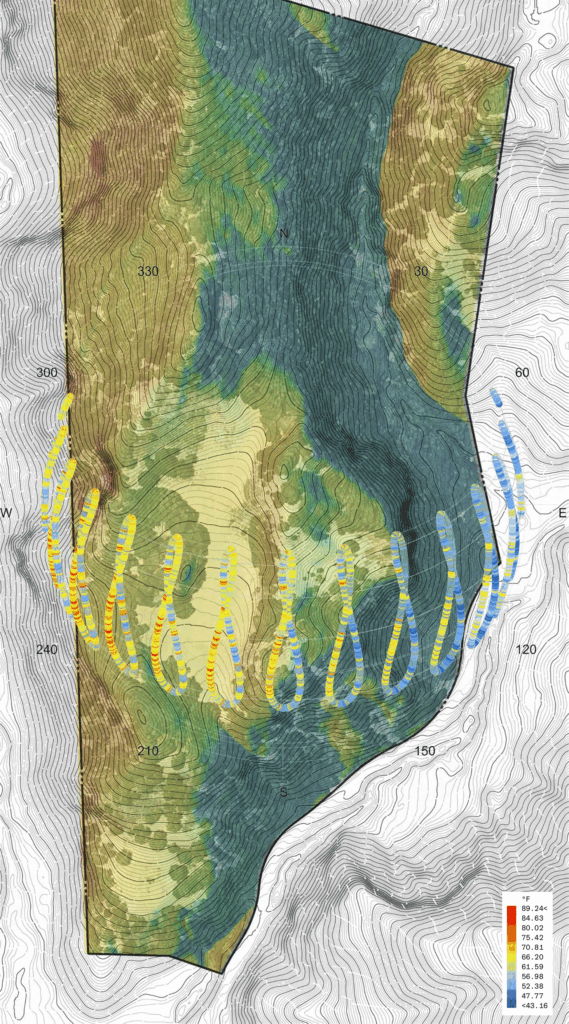
But what if an incorrect intuition were applied to a new visitor’s center in this hottest of national parks? Assuming consistent wind might lead one to design passive systems like the vernacular evaporative cooling towers (badgir) of Middle Eastern deserts. How terrible it would be to realize after construction rather than before design how ineffective such an investment might become. There are real costs to a faulty design intuition. To minimize these costs, we owe it to ourselves and our clients to form the sharpest possible intuition about the places in which we design. Thankfully, we’ve never been closer to the data and tools to conduct this refinement.
REFERENCES
Aspelund, K. (2006). The Design Process. Bloomsbury Academic.
Alhadeff, A. (2021, October 29). The Power of Hunger. Science. 547.
Pallasmaa, J. (2012). The Eyes of the Skin (3rd ed.). John Wiley & Sons.
USEFUL RESOURCES TO GET STARTED
Where to find .epw files: ladybug.tools/epwmap
Rhinoceros modeling software: rhino3d.com
Ladybug plugin for Grasshopper: food4rhino.com/en/app/ladybug-tools
Ladybug tutorials: youtube.com/watch?v=pSZHnAw5Jjk

Camden Greenlee, AIA, is an associate at Clayton Korte in San Antonio. He developed the firm’s environmental design handbook, which outlines best practices for site and climate responsive design.
Design for a Changing Climate

Reimagining the Courtyard House
Shaping the Culinary Experience

Modern Hospitality Meets Cultural Legacy
At the Intersection of Neuroscience and Design

Snøhetta Transposes the Borderland

Designing for Neurodiverse Students




These finishes and furnishings focus on the power of color to influence mood, productivity, and overall well-being.

In Depth: Urban Domesticities Today
Edited by Florian Idenburg, Jing Liu, et al.
Lars Müller, 2025

Concrete Architecture
Phaidon Editors, with Sam Lubell and Greg Goldin
Phaidon, 2024